


Plutonium-238 to power spacecraft
Editorial review 2026
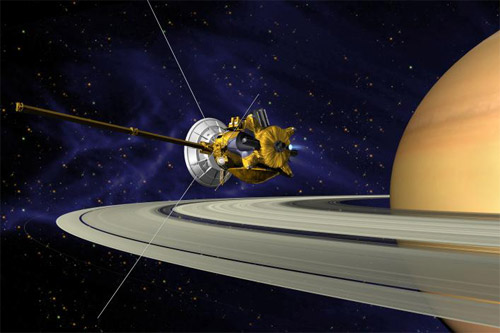
The Cassini probe.
Artist’s impression of the Cassini probe approaching Saturn. Near this distant planet, the light coming from the Sun is only one hundredth of what it is on Earth. Solar panels would be insufficient to provide the probe with energy. To power Cassini and other space probes, NASA used the heat released by the radioactive decay of an isotope of plutonium, plutonium-238.
© NASA
During distant space exploration, beyond Mars, the light coming from the Sun is too weak to power a spacecraft using solar panels. Radioactive decay is therefore used to provide the energy and electricity required to operate these uncrewed spacecraft. The most common generators are radioisotope thermoelectric generators or RTGs (radioisotope thermoelectric generators). RTGs can be considered as batteries capable of supplying a few hundred watts for periods that fuel cells or ordinary batteries could not achieve.
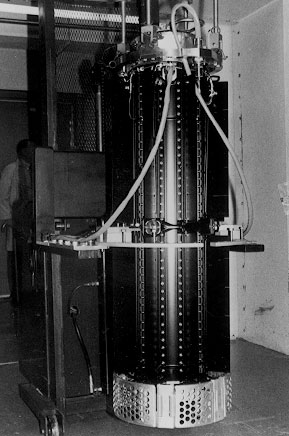
Radioisotope thermoelectric generator
This RTG radioisotope generator converts the heat from radioactive decay into electricity without risk to astronauts. Energy that is not consumed is stored in batteries for other needs and emergencies. This standard RTG used in spacecraft weighs approximately 56 kg, with a length of about 1.13 m and a diameter of 43 cm. Loaded with 10.9 kg of plutonium oxide, it can generate 888 W of electricity and 13,000 watts of heat. © MIT
These generators have supplied electricity for distant and prestigious explorations such as those of the Pioneer, Voyager, Cassini probes, etc… RTGs were also used on Mars with the Viking landers, for scientific experiments on the Moon during the Apollo missions, as well as for satellites.
The radioactive material must meet three requirements: – A lifetime long enough to produce energy continuously throughout the mission and short enough for a sufficient rate of decay to produce a usable amount of heat. The radioactive half-lives of the radioelements used for RTGs are a few tens of years. – A density requirement: high energy production per unit of mass – Low-penetrating radiation: alpha particles accompanied by gamma radiation or neutrons requiring thick shielding.
The requirements in terms of half-life and energy density reduce the choice to around thirty radionuclides, including plutonium-238, curium-244 and strontium-90. Among these, plutonium-238 is the one that requires the least shielding – 2.5 mm of lead – against penetrating radiation. Shielding is not necessary if the fuel casing stops the radiation.
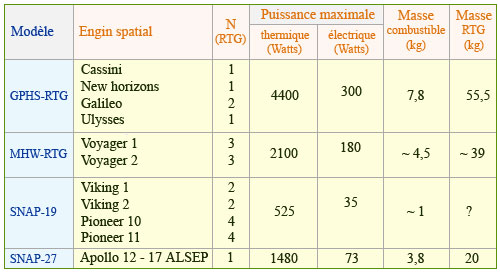
Pu-238 RTG models
Plutonium-238 RTG generators have been used by NASA for its space programme since 1961. The generators supplied electricity to the Pioneer 10 and 11, Voyager 1 and 2, Galileo, Ulysses, Cassini and New Horizons probes, which could not use solar panels for their distant missions. RTGs were also used on Mars with the two Viking landers, for scientific experiments on the Moon during the Apollo 12 to 17 missions, as well as for the Nimbus, Transit and Les satellites.
© LANL
Plutonium-238 is therefore the most widely used radionuclide, in the form of dioxide. This radioelement has a half-life of 87.7 years, a good energy density, and an exceptionally low level of gamma and neutron radiation. Although it is an isotope of plutonium, plutonium-238 is unsuitable for the manufacture of nuclear weapons and does not present a proliferation risk.
Because of its 87.7-year half-life, a generator loses only 0.787% of its power each year. At the beginning of 2001, despite 23 years of travel, the Voyager 1 probe was still sending data back to Earth. Its power, initially 470 W, was still 315 W (it would have been 392 W without a degradation in the efficiency of the thermocouples, which convert the heat from radioactive decay into electricity).
Twelve years later, in September 2013, Voyager I had entered the interstellar medium, which is no longer influenced by the Sun. The space probe was beginning to make the first direct measurements of the physical conditions prevailing in this interstellar medium, providing crucial data on the nature of the Universe on a large scale.
Voyager I was still able to transmit data thanks to the inexhaustible energy of the plutonium-238 available on board. The probe should become silent within a few years because of the lifetime of the thermocouples. Thermocouples are reliable and last a long time, but their lifetime is limited. Their poor efficiency never exceeds 10% and generally ranges between 3 and 7%. Research into technologies aimed at improving this performance in order to reduce the weight of the generator and lower launch costs has not yet been successful.
Generators producing heat without electricity (heater units) have also been used aboard spacecraft such as the Mars Exploration Rovers and the Galileo and Cassini probes.
NEXT: Plutonium-238