


A Tool for Inspections and Adjustments
Editorial review 2026
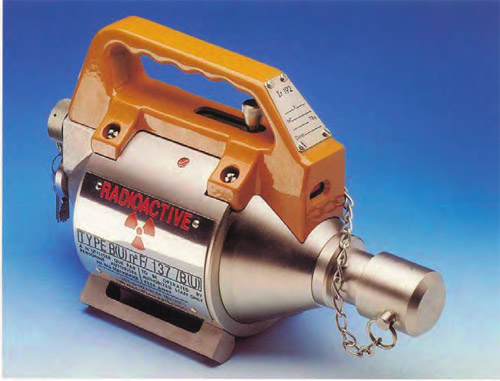
Industrial Radiography Device
An industrial radiography device is generally a mobile unit that can be moved from one worksite to another. It mainly consists of: a radioactive source inserted into a source holder; a source projector used to store the source when not in use and to transport it; an ejection guide tube and a remote-control system used to move the source between the projector and the object being radiographed while ensuring the protection of the operator, who remains at a safe distance from the source. © ASN
The penetrating nature of radiation is commonly used to inspect welds in critical structures such as aircraft wings, reactor casings, oil pipelines, and gas pipelines. In most cases, a source of gamma rays is placed on one side of the material to be inspected and a detector (photographic films were used for many years) on the other side. Any defects can then be detected immediately.
Corrosion in pipelines and piping systems is a recurring industrial problem. By moving a gamma source along one side of a pipe and a detector along the opposite side, it is possible to determine precisely the extent of corrosion from the measured attenuation. In some pipelines, radioactive tracers have been used to locate leaks.
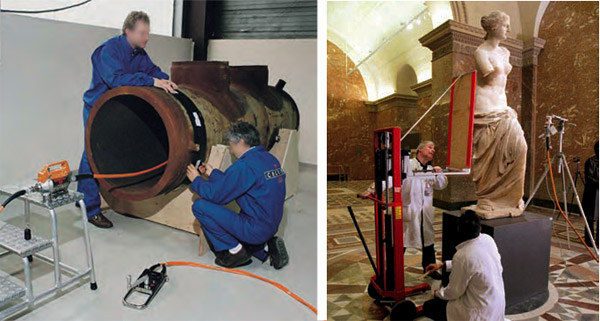
Industrial Radiography Exposure
On the right, it is now the turn of the Venus de Milo to prepare for exposure to radiation that will reveal weaknesses within its internal structure. Museum management decided not to move the statue, making it necessary to take every precaution. Two technicians installed the radiography projector containing the cobalt-60 source whose 1.17 and 1.33 MeV gamma rays will pass through the marble and expose a radiographic film, revealing metal pins left from a repaired fracture that must be preserved. © Défis-CEA
Industrial radiography is a non-destructive inspection technique based on radionuclides that allows operators, using portable equipment, to identify defects and inhomogeneities in metal, particularly in welded joints. This technique commonly uses iridium-192 and cobalt-60 sources whose radioactive activity does not exceed approximately twenty TBq (terabecquerels).
On construction sites and in agriculture, it is often necessary to determine soil density and moisture content. Gamma densitometry is used for this purpose. The equipment operates with two radioactive sources: a cesium-137 gamma source for soil density measurements and an americium-beryllium neutron source for moisture measurements.
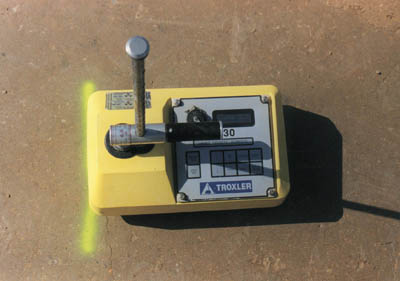
Gamma Densitometry
Measurement of soil density and moisture content, particularly in agriculture and public works. These devices operate with two sealed radioactive sources emitting gamma rays and neutrons. Gamma radiation from cesium-137 (Cs-137) is used for density measurements, while neutron radiation emitted by the americium-241–beryllium (Am-241/Be) source is used to determine moisture levels. © ASN
Monitoring the wear of mechanical components during engine development was one of the earliest industrial applications of radioactivity. The surface of a critical mechanical component (such as a gearbox or bearing) is made slightly radioactive through irradiation. As the surface wears during operation, radioactive material is deposited into the lubricating oil. The oil is then analyzed to determine the amount of metal lost and therefore the degree of wear of the component while the engine is running, without requiring disassembly and reassembly. This results in significant savings in time and development costs.
The emission of characteristic X-rays from atoms present in a material sample, induced by the interaction of radiation with matter, makes it possible to identify the elements contained within the sample.

Measurement of lead in paint. The incident low-energy gamma radiation produces a photoelectric effect within the electron shells. The rearrangement of these electrons generates X-ray emission. If lead is present, the emitted energies can be clearly identified. © Fondis Electronic
The activation phenomenon can also be used to precisely monitor metallic coating layers in the production of specialty steels such as galvanized steel. Other applications include the inspection of nuclear fuel assemblies, the detection of defects in gas turbine blades, and quality control of ceramics.
SUMMARY OF THE TOPICS COVERED
Other articles on the subject « Applications of Radioactivity »
Material Developmnent
Improving the quality of industrial products Editorial review 2026 Every day, we use products who[...]
Non Destructive Testing
Monitoring without causing damage … Editorial review 2026 Radioactive tracers and sources are use[...]
Food processing
Eradicate bacteria, fungi and pests with radiation … Gamma rays are used industrially to en[...]
Agri-food applications
Eliminating bacteria, molds and parasites …. Editorial review 2026 Gamma irradiation is use[...]
Medfly Eradication
The Medfly scourge and its eradication Editorial review 2026 Mediterranean fruit flies, or[...]
Disinfecting Effects
Getting rid of parasites and microbes… Editorial review 2026 The radiobiological action of [...]
Radioactive Gauges
Instruments for monitoring industrial processes Editorial review 2026 Modern industry, in [...]
Sources in Industry
A wide variety of applications Most of the radionuclides contained in radioactive sources are ext[...]
Various Applications
From Environmental Monitoring to Oil Exploration … Editorial revision 2026 Because of the f[...]