


The distant legacy of the Cold War
Editorial review 2026
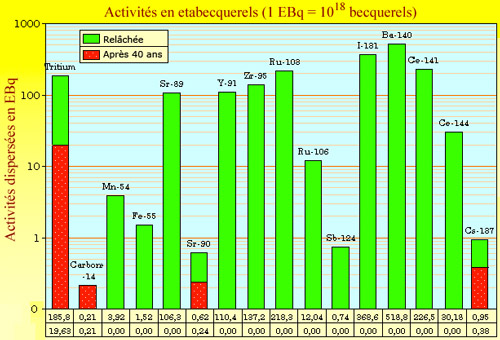
The equivalent of two and a half years of natural radioactivity
Atmospheric nuclear tests dispersed large quantities of radioactive elements, as shown by the estimate of the global activities of the main radioactive elements released. Due to radioactive decay, the contamination remaining about 40 years after the end of these tests (in red) concerns tritium, carbon-14, strontium-90 and cesium-137. As a result of these tests, humanity would have been exposed to the equivalent of two and a half years of natural radioactivity.»
© IN2P3 – Source G.Gerber
A legacy of the Cold War and the race for atomic weapons, the nuclear tests carried out by the major powers from 1945 to 1980 are at the origin of a residual radioactive contamination that still persists. H-bombs or hydrogen bombs based on fusion, although more powerful, caused less fallout than atomic bombs.
The effect of fallout has diminished over time. Initially, at the height of testing in the 1960s, annual doses reached 0.100 mSv/year. Today the annual dose is on the order of 0.005 mSv/year in a European country such as Belgium, far from the test sites.
This exposure is low compared with the 1.5 mSv received on average from medical examinations, but it represents a relatively significant part of the residual artificial radioactivity outside these examinations.
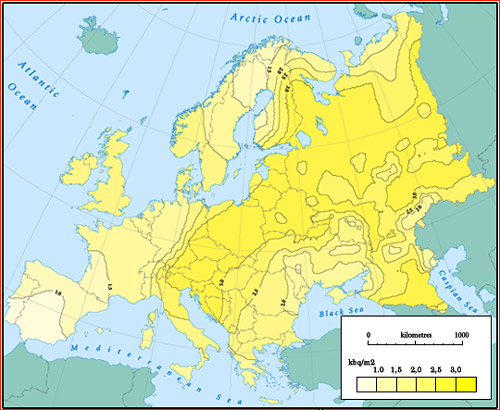
Cesium in Europe before Chernobyl
A legacy of the Cold War, the main contaminations remaining 30 years after the end of atmospheric nuclear tests were due to cesium-137 and, to a lesser extent, strontium-90, two radioactive nuclei whose half-life is about thirty years. The map shows the distribution in Europe of cesium-137 deposits just before the Chernobyl accident in 1986. Ground contamination was on the order of kilobecquerels per square meter, contamination having by then been divided approximately by two since the 1950s-60s.
© Atlas de Tchernobyl
It is higher than that released by nuclear power plants and than the residual radioactivity from Chernobyl outside the most affected zones.
Most of the radioactivity from high-yield explosions was injected into the stratosphere where it remained on average for 7 years before being deposited three-quarters in the northern hemisphere and one-quarter in the southern hemisphere.
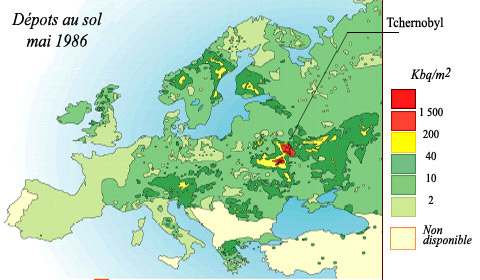
Cesium in Europe after Chernobyl
Numerous measurements made it possible to establish the map of ground activity of cesium-137 after the accident. This activity – expressed here in kilobecquerels (kBq) per square meter – was added to the residual fallout from nuclear tests. The map shows contamination levels nearly 1000 times higher near Chernobyl than in Western Europe because of distance effects. Overall, the Chernobyl releases represented about three times the residual activity in 1986 from nuclear tests. © IRSN
The total collective committed dose resulting from atmospheric tests has been estimated at 30 million man-sieverts. Distributed over 5 billion individuals, it represented two and a half years of exposure to natural radioactivity, or 6.0 mSv per person.
In terms of activity, the principal remaining radioelements are tritium (widely spread by hydrogen bombs), carbon-14, cesium-137 and strontium-90. In terms of effective doses, the principal contribution comes from carbon-14 (70%), followed by cesium-137 (13%). Contamination due to tritium and carbon-14, elements produced by cosmic radiation, is not considered worrying.
Because of its radioactive half-life of 5730 years, carbon-14 resulting from nuclear tests will disappear very slowly. It may disturb carbon-14 dating carried out by our descendants. The excess resulting from atmospheric tests compared with carbon-14 originating from cosmic radiation is about 2%. Most of this carbon is found in the ocean, with 1.6% remaining in the troposphere. Relatively little attention is paid to tritium, which is very weakly toxic. It decreases with a 12-year half-life.
The elements requiring monitoring are cesium-137 and strontium-90 whose half-life is 30 years.
Other articles on the subject « Accidental Releases »
Atmospheric Releases
Radioactive air pollution after a major accident Editorial review 2026 During a major nuclear acc[...]
Risks of ground deposits
The two modes of deposition: dry and wet deposition Editorial review 2026 In everyday life, away [...]
Risks of Internal Exposure
After an accident: What impact on food and humans? Editorial review 2026 A large amount of radioa[...]
Exposition modes (accident)
What are the exposition pathways after a major accident ? Editorial revision 2026 What is the imp[...]