


Radon: a carcinogenic agent
Editorial revision 2026
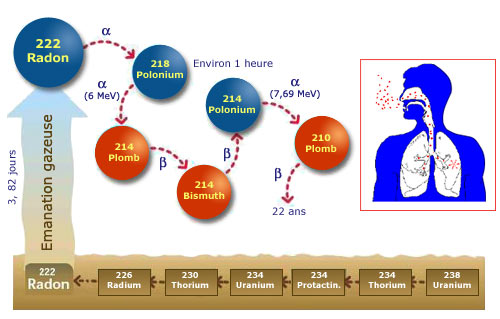
From the ground to the lungs
Radon released from the ground as a gas transforms, within about an hour, into an isotope of lead, lead-210. During this transformation, it passes through intermediate nuclei whose atoms, being metallic in nature, can be deposited in the lungs if the gas and its decay products are inhaled. Two of these intermediate nuclei, polonium-218 and polonium-214, emit alpha radiation, which is harmful to lung cells when in direct contact with them.
© IRES/IN2P3
Although present in infinitesimal quantities in the atmosphere, radon is a radioactive gas. Once inhaled, radon continues to undergo radioactive decay inside the lungs. Its solid decay products irradiate the most sensitive cells of the bronchi. In 1987, the WHO (World Health Organization) recognized radon as a human lung carcinogen.
Estimates of the risk associated with radon are based on earlier studies of workers in uranium mines. These studies established that excessive exposure increased the risk of lung cancer. Prevention of this risk in mines today relies primarily on ventilation of underground galleries.
Radon has the particular characteristic of being the densest of all gases. In enclosed premises, it remains at ground level and accumulates in confined spaces such as houses, particularly in basements. Vigilance is therefore required in homes, but radon is a source of natural radiation exposure on which people can take action.
The concentration of radon in air is measured in Bq/m3, the number of radioactive decays per cubic metre per second. Across France, the average concentration in homes is 90 becquerels per cubic metre (Bq/m3), compared with 20 Bq/m3 in England and 108 Bq/m3 in a granitic country such as Sweden. These averages conceal considerable disparities.
As a lung carcinogen, however, radon ranks far behind tobacco, which causes 44,000 deaths each year in France. It is estimated that lifelong exposure to air containing 3,000 Bq/m3 of radon (a very high concentration) would be equivalent to smoking 20 cigarettes a day.
With an average concentration of 90 Bq/m3, the average person in France is exposed to the equivalent of 0.6 cigarettes per day. The risk is generally low, but unevenly distributed: one person in a hundred lives in a home where the concentration exceeds 1,000 Bq/m3 (the equivalent of 6 cigarettes).
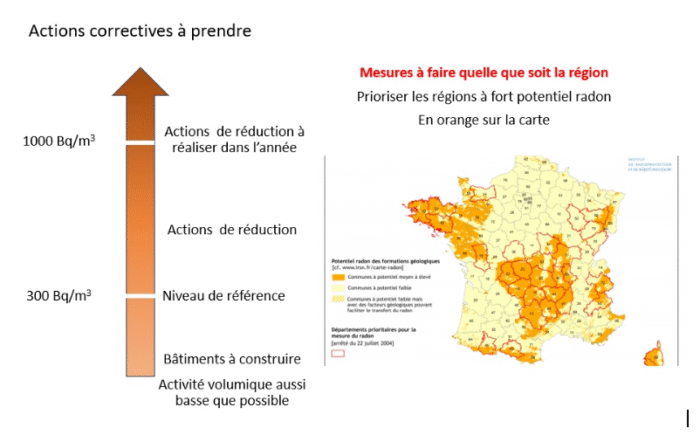
Monitoring and corrective measures. The Order of 27 June 2018 defines the map of municipalities exposed to radon. Measurements are mandatory in workplaces and in certain establishments open to the public, such as educational establishments, including boarding facilities; collective childcare facilities for children under six years of age; healthcare, social and medico-social establishments providing accommodation, including healthcare facilities, military hospitals, establishments such as retirement homes and EHPADs, thermal establishments, and prisons. There is no obligation for private homes, apart from the requirement to provide information between sellers and buyers. © Map IRSN – ASNR / MA
Regulations
To assess population exposure, ASNR has been carrying out radon measurement campaigns in homes for several years. Whatever the type of building (home, school, workplace), the only way to determine whether it has a high radon concentration is to have the radon level measured by a specialized organization. Based on these measurements, there are estimated to be 300,000 buildings in France where the average annual concentration exceeds 300 Bq/m3 and 60,000 buildings where the average annual concentration exceeds 1,000 Bq/m3.