


In our glasses and on our plates…
Editorial revision 2026
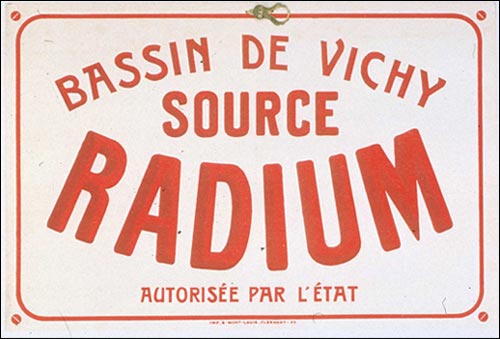
An advertisement from another era…
There is no escaping radioactivity. Granite rocks are
slightly radioactive due to the presence of thorium,
uranium and their decay products. A famous thermal spring
used to boast about this at a time when radioactivity had a good reputation.
Seventy years later, another spring in the region preferred to
rely on the smile of a popular footballer against a backdrop of the volcanoes
of Auvergne to promote the excellence of its water. All waters
currently on the market have relatively low levels of radioactivity,
as do foods.
© ANDRA
It is impossible for us to escape radioactivity when we breathe and move around. It is also impossible to escape it when we eat. All our food is slightly radioactive because it contains elements such as carbon-14 and potassium-40, radioactive isotopes that are inseparable from naturally occurring carbon and potassium.
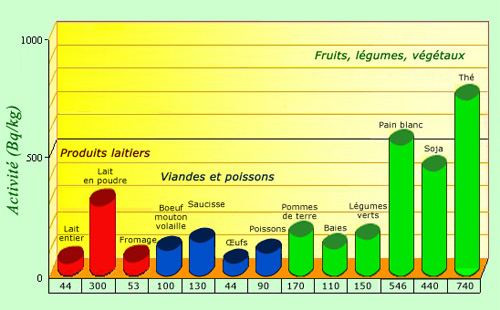
Food is naturally radioactive!
The food we eat is slightly radioactive, as shown by the activity levels measured in these common foods. Activities of a few hundred becquerels (Bq) per kilogram or per litre may seem high. For comparison, the activity of our bodies amounts to several thousand becquerels: 8,000 Bq for a 70 kg man.
© IN2P3 (Source: G. Gerber)
The spring water we drink is radioactive. Before emerging from the ground, it has dissolved mineral salts from the rocks it encountered along its path, some of which contain radioactive elements. The most radioactive waters come from granite or volcanic regions, whose rocks contain small amounts of uranium and thorium, together with the radioactive elements in their decay chains. This radioactivity varies greatly.
A 2015 IRSN assessment estimates the average exposure in France due to water and food at 0.55 mSv per year.
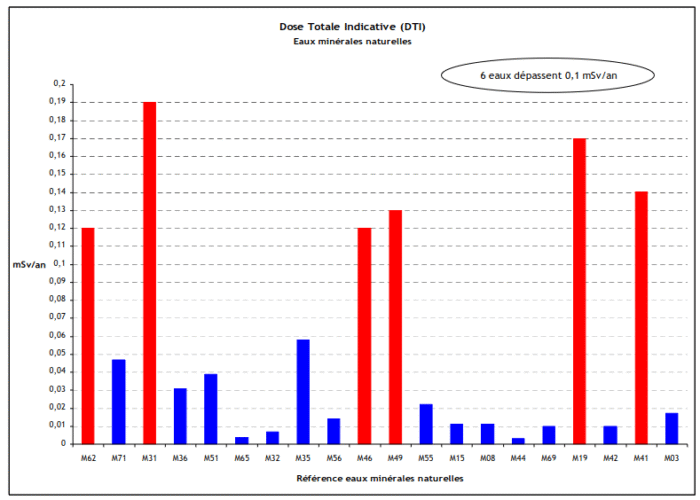
Estimated total indicative dose (TID) for 20 natural mineral waters (in mSv/year). Source: Directorate General for Health and Institute for Radiation Protection and Nuclear Safety. Radiological quality of bottled water produced in France, 2007, p. 51.
In the United States, the average radioactive activity of water consumed in households is 18.5 becquerels per litre (Bq/litre). These activity levels, like those found in food, are harmless, given that the becquerel is a very small unit. Legislation imposes limits on the activity of food, with cautious limits because, due to uncertainty about the effects of low doses, the precautionary principle is applied.
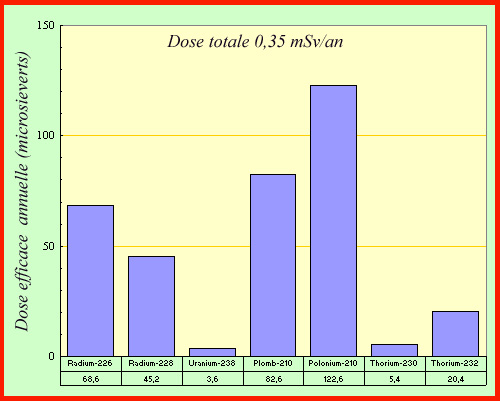
Analysis of spring water
Water is slightly radioactive because it contains trace amounts of radioactive mineral elements dissolved from the rocks through which it has passed. Here, for a spring water, the annual radiation exposure dose has been estimated for an infant who drank one litre of this water every day for a year. This represents maximum exposure, as infants are more sensitive to radiation than adults. The contributions of radioactive elements to the annual dose are expressed in millionths of a sievert.
© IN2P3 (Source: H. Vanmarcke)
After the Chernobyl accident, French radiation protection authorities were criticised for allowing the consumption of food whose activity exceeded accepted standards. These exceedances were probably too sporadic to have had significant effects, but the lack of transparency and the impression that the risks were being concealed undermined trust in experts, a psychological disaster whose consequences are still being felt.
Another example of these concerns is the fear surrounding the irradiation of certain foods using radioactive sources, an effective technique used to sterilise them without changing their taste. Irradiation leaves no radioactive residue and has no harmful effects, as confirmed by WHO documents. Until recently, irradiation was used for pepper and spices, which present significant health risks from bacterial contamination when they are not sterilised. A regulation made the wording “sterilised by ionisation” mandatory. Fearing rejection by their customers, some manufacturers have stopped using it and now use less effective processes.

The wording “sterilised by ionisation”
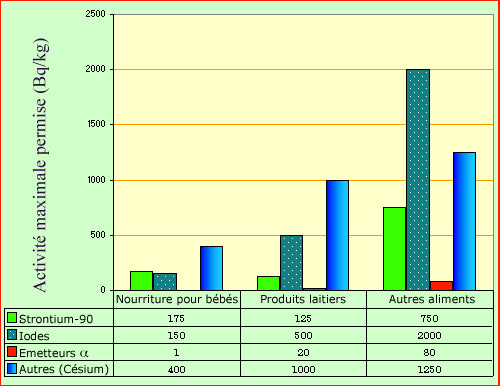
Some maximum limits…
Maximum limits permitted in the European Community for various radioactive elements according to the type of food. These limits are given in terms of activity (becquerels) per kilogram. The more toxic the radioactive element is (as is the case with alpha emitters such as plutonium), the lower the permitted activity must be. The strictest limits apply to baby food. For foods consumed in small quantities (less than 10 kilograms per year), activity levels up to ten times higher than those indicated are permitted.
© IN2P3/ (Source: G. Gerber)
As with blood alcohol limits for driving, limits on the radioactivity of elements have been revised downwards over the past fifteen years: safety margins have been increased, which amounts to overestimating the risks. This approach, intended to reassure and applied mainly to the ingestion of contaminated food, has had the effect of increasing anxiety surrounding the effects of radioactivity and ionising radiation.
Other articles on the subject « Natural Radioactivity »
Natural Origins
From Remnants of the Earth’s Formation to Cosmic Rays 2026 Editorial Revision Humans have a[...]
Uranium and thorium origins
Radioelements as old as the Earth and their descendants Editorial revision 2026 The main source o[...]
Cosmogenic Radioelements
The Formation of Radioelements from Cosmic Rays 2026 Editorial Revision The Earth is constantly b[...]
Natural Exposure
A chronic but benign exposure All exposure to radioactivity, whether natural or artificial, is me[...]
Ground Radioactivity
Terrestrial Exposure or Radioactivity Emanating from the Ground 2026 Editorial Revision The Earth[...]
Human Internal Exposure
Our bodies are also… slightly radioactive Editorial revision 2026 More than half of interna[...]