


Identifying the Sources of Very High-Energy Cosmic Rays
A very recent field of science, gamma-ray astronomy focuses on gamma rays arriving from the most distant regions of space.
Gamma-ray astronomy is particularly interested in very high-energy gamma rays. The interest of gamma rays is that their direction points back to their place of origin. The interest of high energies is that they make it possible to locate in the Universe the sources capable of imparting such enormous energies to particles.
The particles detected on Earth or aboard satellites cover an extremely wide energy range. The most energetic particles reach around ten joules, an extraordinarily high energy for a particle (1 joule is equivalent to 6.25 billion billion electronvolts). These ultra-rare particles provide an indication of the power of the cosmic accelerators responsible for such energies.
Let us recall that the energy of gamma rays produced by radioactivity rarely exceeds the MeV (million electronvolt) range. Particle accelerators generate particles with energies reaching hundreds of thousands of MeV, or GeV. These accelerators are themselves surpassed by the extraordinary acceleration capabilities found in the cosmos near sites such as supernovae, pulsars, or active galactic nuclei (AGN), galaxies that likely contain a black hole at their center whose activity generates ultra-relativistic particle jets that we can detect.
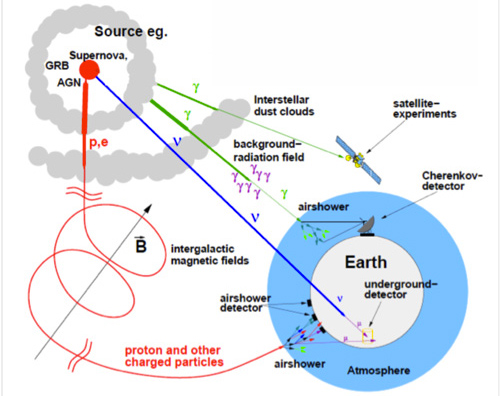
Path of cosmic rays
Supernovae, pulsars, and active galactic nuclei are sources of very high-energy cosmic rays. The path followed by these rays, which may eventually reach detectors aboard satellites or located on the Earth’s surface, depends on their electric charge. Charged particles such as protons and electrons are deflected by the magnetic fields present throughout galactic space. Neutral particles, however, such as neutrinos and gamma rays, travel in straight lines. If detectors are capable of measuring their direction, that direction points directly back to their source.
© Michael Backes: Temporal and spectral behavior in the multi-wavelength context, Technische Universität Dortmund, PhD thesis 2011
Understanding the Production and Acceleration Mechanisms of Radiation
Understanding the production and acceleration mechanisms of this radiation is of major interest both in astrophysics and particle physics. Unfortunately, most of this radiation consists of charged particles and, except at the highest energies where statistics become extremely limited, their place of origin remains unknown. Indeed, the presence of intergalactic magnetic fields, which are still poorly understood, makes locating and identifying the sources difficult. The use of the rare neutral particles (photons and neutrinos) contained within this radiation not only circumvents this difficulty but also makes it possible to indirectly study the charged radiation from which they originate.
A remarkable example of the use of photons to study high-energy cosmic radiation and its sources is provided by the mapping of the sky carried out by the LAT (Large Area Telescope) experiment aboard the FERMI mission. The Milky Way exhibits a continuous band of gamma radiation generated by interactions between cosmic rays and interstellar gas. Superimposed on this continuum are point sources that reveal the existence of acceleration sites or significant concentrations of interstellar matter.
The energy detection range of LAT, extending from a few MeV to several tens of GeV, is three orders of magnitude lower than the energy range studied by the H.E.S.S. experiment, and far below the energies of ultra-high-energy cosmic rays. Nevertheless, this example clearly illustrates the fundamental principles of gamma-ray astronomy.
Gamma-ray astronomy emerged more than twenty years ago. It covers a vast energy range extending from hundreds of keV to several tens of TeV (1,000 billion electronvolts), spanning nearly nine orders of magnitude.
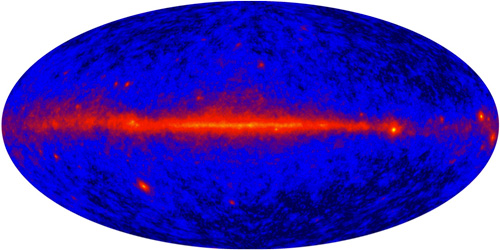
Gamma-ray map of the sky
This map of high-energy cosmic radiation and its sources is provided by the LAT experiment of the FERMI mission. In this map of the sky, the Milky Way displays a continuous band of gamma radiation generated by interactions between cosmic rays and interstellar gas. Superimposed on this continuum are point sources that reveal the existence of acceleration sites or significant concentrations of interstellar matter.
© LAT
At even higher energies, between 100 TeV and 1,000 TeV, the absorption of gamma-ray photons by the diffuse intergalactic background radiation considerably limits the observable horizon for extragalactic sources. At still higher energies, distinguishing photons from other forms of radiation remains beyond the capabilities of current techniques. To appreciate the scale of this field of research, studies extending from low-energy radio waves to X-rays already cover eleven orders of magnitude of the electromagnetic spectrum.
The study of the entire emission spectrum, from radio wavelengths up to these extreme energies, makes it possible to understand the mechanisms responsible for the production and acceleration of particles in environments where violent phenomena occur, such as supernovae (stellar explosions), the surroundings of pulsars (collapsed, rapidly rotating stars), or more exotic objects such as galactic black-hole systems known as “microquasars.” The sensitivity of these experiments also makes it possible to detect more distant objects beyond our Milky Way, such as active galactic nuclei (AGN)—galaxies that likely contain a black hole at their center whose activity generates ultra-relativistic particle jets that we can detect—as well as galaxy clusters and the remnants of galaxy collisions.
While the detection of gamma radiation allows scientists to study its sources, its non-detection can also help us understand the content of our Universe. As mentioned above, during their journey high-energy gamma rays may be absorbed through interactions with low-energy photons in the infrared or visible range, which physicists refer to as the infrared or optical diffuse background. The density of this infrared or optical background is still poorly known and is fundamental to understanding the formation of stellar structures. Thus, the broad energy range of gamma rays makes it possible to study this diffuse background and determine its density. Indeed, at the upper end of the gamma-ray energy range, the energy released during an interaction with diffuse background photons is sufficient to materialize an electron-positron pair. Gamma-ray photons that interact in this way escape detection. This manifests itself as a break in the evolution of the energy spectrum above a certain threshold. Measuring this gamma-ray deficit therefore provides an indirect measurement of the density of the diffuse background present in intergalactic space.
Finally, it should be noted that, according to our current knowledge, observations indicate that we can directly account for only 4.5% of the content of the Universe. The remainder consists of energy or matter (referred to by physicists as dark energy and dark matter) that is either beyond the reach of our detectors or of an unknown nature. In the latter case, studies are underway to reveal its nature through the distortions it could produce in the energy spectra reconstructed by these experiments.
Pascal Vincent