


Artificial radioactivity: the price of better medicine
Editorial revision 2026
For about a century, humans have been exposed to sources of radiation other than natural radioactivity, which nevertheless remains the main source of exposure. Most of these new sources are beneficial. We receive more radiation than our ancestors as a result of advances in medicine. The additional doses remain modest.
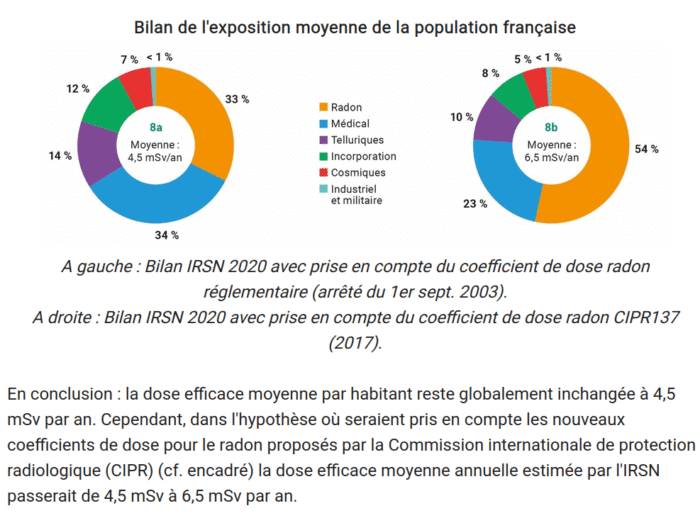
The distribution of the main sources of radiation exposure in developed countries shows the
predominance of medical sources in human-made exposure. The contribution from non-medical sources is
currently mainly due to nuclear fallout (atomic testing, operation of nuclear power plants,
Chernobyl). In Western Europe, nuclear fallout accounts for less than 1% of the total. Adapted from Bilan de l’exposition de la population française aux rayonnements ionisants (p. 22), by the Institut de radioprotection et de sûreté nucléaire (IRSN), 2021.
The dominant share of medical exposure
Apart from personnel who are exposed to ionising radiation as a result of their work and from accidental situations, the additional dose comes almost entirely from medical examinations and certain therapies.
On average, medical diagnostic procedures in France result in an effective dose of approximately 1.57 millisieverts (mSv) per individual per year. It is estimated that there are 70 million radiology procedures (or procedures using ionising radiation) per year. IRSN 2024 report on 2022 values. This is a slight increase compared with 2017 (1.53 mSv).
This value is in the upper third of the average values of European Union countries and is much lower than that of the European country whose population is the most exposed, Belgium (2.7 mSv per year per inhabitant).
These are averages, as doses naturally vary greatly from one person to another, depending on age and state of health. It is difficult to reduce these doses other than by improving equipment. Giving up X-rays, CT scans and nuclear medicine examinations would mean giving up the advances of modern medicine.
However, ionising radiation is used only when justified. When it is justified, it is used as effectively as possible. Doses are limited according to the objective to be achieved. In radiation protection, the principles of justification, optimisation and justification are the rule for exposure to non-natural ionising radiation.
Nuclear power and other contributions: low exposures …
Of the 1.6 mSv from non-natural sources, the contribution from non-medical sources is estimated at 0.050 mSv. Contrary to a widespread belief, fallout from nuclear energy and atomic testing represents on average only 0.020 mSv, or 1 to 2% of the total. This low figure results from the precautions taken in reactor cores to isolate the radioactive materials present behind several protective barriers. People living near a nuclear reactor receive three times less radiation from it per year than they do during a transatlantic flight.
Thus, the annual collective dose released by a PWR reactor, which supplies electricity to approximately one million inhabitants in France, is equivalent to the natural radioactivity received by around thirty people.
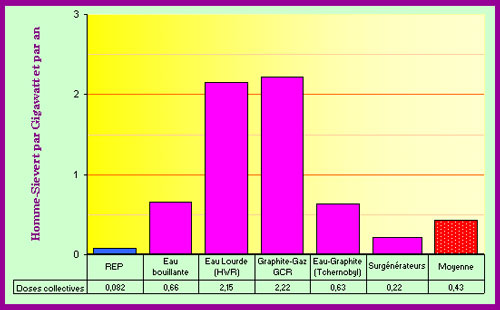
Polluting impact of reactor technologies
The polluting impact of an operating reactor technology is measured by the annual collective dose released into the environment. This dose, measured in “person-sieverts”, is expressed per gigawatt of installed electrical power. Of all reactor technologies, pressurised water reactors (PWRs) produce by far the lowest releases. The excellent performance of PWRs is due to the presence of three protective barriers in these reactors: the secondary water circuit that drives the generators is not in contact with the core containing the radioactive materials.
© IN2P3 (Source G. Gerber and United Nations).
The treatment of highly radioactive fuel discharged from nuclear power plants prevents it from being dispersed. Its conditioning, compaction and storage at protected sites ensure that it has no impact on the environment, at least on a human timescale.
After the Second World War and during the Cold War, the major powers carried out tests in the development of atomic bombs and hydrogen bombs. These tests were conducted mainly in the open air during the 1950s and 1960s. They released radioactive nuclides into the atmosphere. After the 1960s, tests were conducted underground and were therefore less polluting. Exposure to these releases represented approximately two years of natural radioactivity. The dispersion of radioactive elements across the entire surface of the Earth and the passage of time have had their effect: doses resulting from nuclear test fallout are now a few millionths of a sievert.
The danger of radiation. An expert’s perspective: A distrust of Science, by Yvon Grall, professor emeritus of biophysics and nuclear medicine
Articles on the subject « Artificial Radioactivity »
Medical exposures
The main source of non-natural exposure Editorial revision 2026 Apart from natural radioactivity,[...]
Nuclear Activities
Nuclear plants : Very low exposures under normal conditions In what seems a paradox, nuclear powe[...]
Radioactive Sources
Sealed Sources and Tracers: Multiple Applications 2026 Editorial Revision Tiny quantities of radi[...]