


Museums that contain radioactive objects
Editorial review 2026
Radioactivity is present everywhere, as you know. But what you may not know is that some museums contain historical objects (sometimes unique) that are radioactive.
Here are a few examples:
The Curie Museum, which displays historical objects and documents used in the work of Pierre and Marie Curie. Some of these items are still radioactive because they are (slightly) contaminated with radium. The National Library of France, which holds several works by Pierre and Marie Curie. The Air and Space Museum, which preserves old aircraft instrument dials that glow in the dark. Once again, radium is responsible.
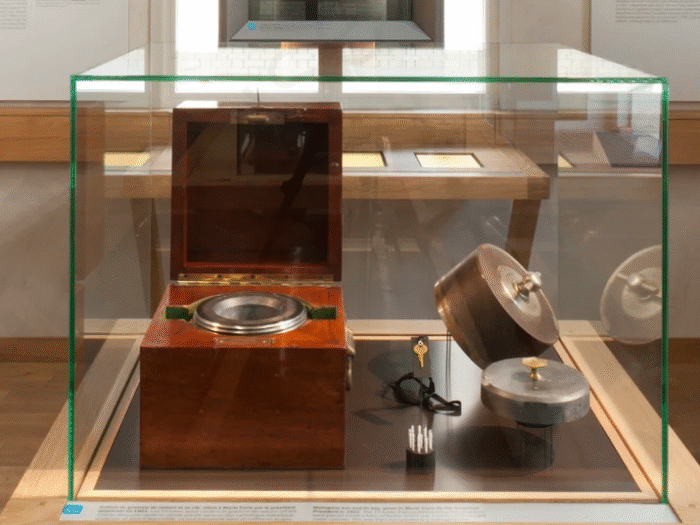
Marie Curie was received in the United States by President Warren Harding to receive one gram of radium. American women had raised the funds so that Marie could continue her research. A special box (with lead shielding) had to be designed to transport this gram of radium back to France. It is now on display at the Curie Museum. © Curie Museum
The storage collections of the National Conservatory of Arts and Crafts, which contain several objects of different types. The National Museum of Ceramics in Sèvres, which houses pieces colored with uranium oxide. Mineralogical museums such as the Geology Gallery of the National Museum of Natural History in the Jardin des Plantes, or the collection of Sorbonne University Pierre and Marie Curie, also contain radioactive specimens. We will take you on a tour of these places steeped in history.
You may be surprised to discover that natural or artificial radioactivity can sometimes lead to significant exposure to ionizing radiation.
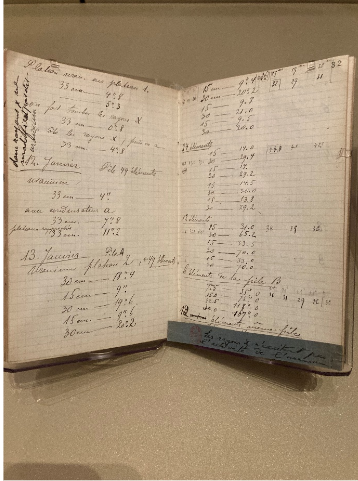
In the museum of the National Library of France, laboratory notebooks belonging to Pierre and Marie Curie were exhibited.
To ensure that visitors were not exposed, we carried out dose-equivalent rate measurements as well as contamination measurements when these notebooks were removed from display. © BNF
Articles on the subject « Cultural heritage objects »
The Curie Museum
The Radium Institute Editorial review 2026 The Curie Museum is located in one of the former build[...]
The Natural History Museum
The Natural History Museum 2026 editorial revision In the Jardin des Plantes in Paris, there is a[...]
The National Library of France
The National Library of France holds part of the Curie archives Editorial review 2026 It holds, f[...]
The other museums
Editorial review 2026 Many other museums hold radioactive objects that are sometimes displayed (b[...]