


Radioactivity and Cultural Heritage
Editorial review 2026
Nuclear techniques are used in cultural heritage. Before being displayed in museums, the remains of past civilizations must be identified and analyzed. These analyses help guarantee the authenticity of artifacts and provide the maximum amount of archaeological and historical information. Moreover, their great age has made these objects fragile: they must be treated and protected so that many future generations can continue to admire them. Here are a few examples of applications:
The ashes recovered from the Chauvet Cave were analyzed. Their carbon-14 content made it possible to date the period during which prehistoric humans frequented the cave to more than 35,000 years ago.
A medieval wooden statuette was impregnated on its surface with a resin that was hardened by irradiation. Thanks to this treatment, it can now finally be displayed to the public.
At the Carnavalet Museum in Paris, Neolithic dugout canoes discovered along the banks of the Seine are on display. One of them was consolidated by irradiation: there is no longer any risk of seeing it crumble into dust.
The mummy of a great pharaoh traveled from Cairo to Paris. Before returning to its country, it was irradiated with gamma rays in order to destroy all the microorganisms that were deteriorating it.
The paintings displayed at the Louvre Museum are not forgeries. AGLAE, an accelerator at the Research and Restoration Center of the Museums of France, guarantees their authenticity. The C2RMF also possesses numerous X-ray generators.
On the Giza Plateau, physicists use cosmic muon radiation to examine the interior of the Pyramid of Khufu and discover previously unknown cavities.
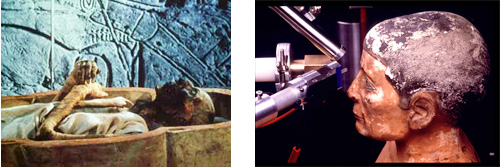
Sterilization and Paint Analysis
Left: sterilization at the CEA of the mummy of Ramses II; Right: ion beam analysis of a detail of the eye of an Egyptian scribe at the Louvre Museum
© CEA and Louvre Museum
SUMMARY OF THE TOPICS COVERED
– Understanding Cultural Heritage: Analysis of objects and cultural heritage studies: identification and provenance of materials, analysis and manufacturing techniques.
– The Atom in the Museum: An accelerator at the Louvre: nuclear techniques and the AGLAE accelerator at the Louvre Museum.
– Conservation: Conservation of ancient objects: preservation and consolidation methods. Sterilization of ancient artifacts.
– Muon Imaging: Radiography of a pyramid