


Monitoring without causing damage …
Editorial review 2026
Radioactive tracers and sources are used to monitor manufacturing processes in large-scale industry. These controls are called non-destructive because they do not damage the integrity of the materials used.
Tracers were generally chosen with a short radioactive half-life so that they would disappear rapidly from the environment into which they had been introduced. However, the ASNR no longer authorizes the use of this type of marker.
Used in extremely small quantities (A tiny amount is sufficient for detection, because the tracer is highly active due to its short half-life), they do not alter the behavior of a mechanical component or of a substance in a chemical process. Detection is extremely sensitive. Only a few becquerels per liter are sufficient to detect a gamma-emitting tracer.
Industrial processes such as gas flows inside a column or the mixing of components in a hopper can be studied by introducing radioactive products. These tracers are monitored in real time by detectors and make it possible to determine their pathways. This knowledge helps optimize industrial processes.
Industrial X-ray and gamma radiography
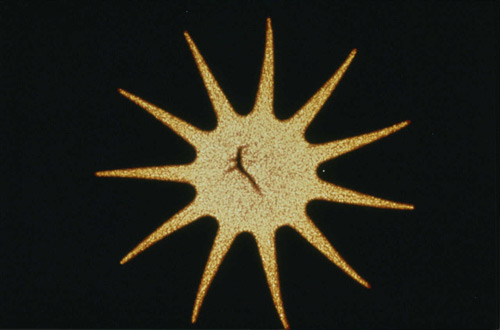
Detection of a defect in a turbine wheel for an engine (with a total diameter of 4.5 cm) by X-ray tomography at CEA-Ripault. Radiography consists of recording the decrease in intensity of X-rays and gamma rays passing through an object, making it possible to reveal defects. Radiography using gamma rays (gamma radiography), which are more penetrating than X-rays, allows the examination of larger objects, up to an entire truck, in the search for drugs or explosives.
© CEA-CADAM
Car body sheets are produced by a rolling line in which the thickness of the sheet is continuously monitored thanks to a radioactive source and a detector located on either side of it: as soon as the specifications are exceeded, the machine must be adjusted. Quality control is greatly improved and waste is reduced.
Disposable lighters are checked at the end of the production line using a radioactive source. The transmission of radiation through the lighter body provides information about its filling level and automatically removes defective products.
Among non-destructive testing techniques, gamma radiography must also be mentioned. Gamma radiography uses gamma rays, which are more penetrating than X-rays. This technique makes it possible to detect defects in the uniformity of metals, particularly in weld seams.
In agriculture, non-destructive controls are also used, although less frequently. For example, one technique uses an unstable isotope of nitrogen as a tracer to optimize fertilizer quantities as well as the best locations and timing for its application. This allows better use of soil fertility and irrigation while reducing environmental damage.
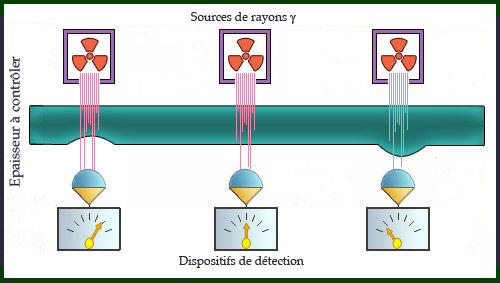
Principle of a thickness gauge
A gamma radioactive source makes it possible to continuously monitor the thickness of a sheet during a rolling process in order to guarantee constant thickness. A detection device measures the quantity of gamma radiation that has passed through the sheet. Gamma absorption depends on the thickness crossed. If the sheet has excess thickness (right), the gamma rays from the source are more strongly attenuated. Conversely, below the nominal thickness (left), they are less absorbed.
© IN2P3
Thickness or level gauges represent 70% of sealed sources. A sealed source is a radioactive source enclosed within a leak-tight casing. They are used to perform measurements of thickness, density, weight and level. Medium- to high-activity sources installed in fixed positions are commonly used. For more information, see this resource from the International Atomic Energy Agency (IAEA).
Radiation produced by radioelements or accelerators is used in industrial processes only when no less restrictive alternative method exists. The assessment of the benefits provided by these methods takes into account the many necessary safety and regulatory measures.
See also:
Markers and tracers
Other articles on the subject « Applications of Radioactivity »
Inspection and controls
A Tool for Inspections and Adjustments Editorial review 2026 The penetrating nature of rad[...]
Material Developmnent
Improving the quality of industrial products Editorial review 2026 Every day, we use products who[...]
Food processing
Eradicate bacteria, fungi and pests with radiation … Gamma rays are used industrially to en[...]
Agri-food applications
Eliminating bacteria, molds and parasites …. Editorial review 2026 Gamma irradiation is use[...]
Medfly Eradication
The Medfly scourge and its eradication Editorial review 2026 Mediterranean fruit flies, or[...]
Disinfecting Effects
Getting rid of parasites and microbes… Editorial review 2026 The radiobiological action of [...]
Radioactive Gauges
Instruments for monitoring industrial processes Editorial review 2026 Modern industry, in [...]
Sources in Industry
A wide variety of applications Most of the radionuclides contained in radioactive sources are ext[...]
Various Applications
From Environmental Monitoring to Oil Exploration … Editorial revision 2026 Because of the f[...]