


Exposure to cosmic rays
Editorial review 2026
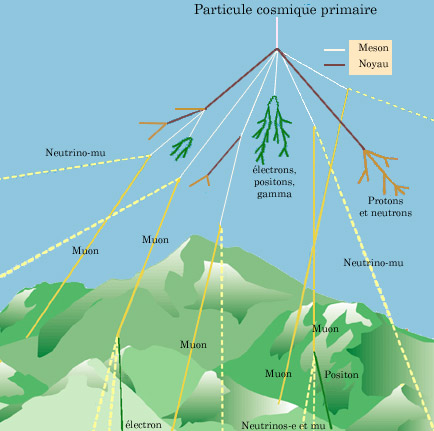
A shower of particles
Particles coming from the cosmos have travelled a long way to reach the Earth. They are stable particles: protons, light nuclei, as well as gamma rays and electrons. When they have very high energy, they generate a shower of particles through a cascade of collisions and decays. Some particles, such as mesons, are very short-lived. Others, such as muons, are sufficiently penetrating and live long enough to reach the ground. Cascade decays produce neutrinos.
© IN2P3
The Earth is constantly bombarded by very high-energy particles coming from galactic and extragalactic space. These cosmic rays have various origins and energies.
They come mainly from the Sun, exploding stars (supernovae), pulsars or phenomena in the distant cosmos. When primary cosmic rays collide with nuclei in the atmosphere, they produce a cascade of secondary particles. Some of the secondary particles produced in cosmic showers reach ground level.
Our bodies are traversed by hundreds of charged or neutral particles per second (around 200 particles per second). Among the charged particles are muons, unstable particles related to the electron, capable of travelling long distances through the atmosphere. In addition, 65 billion neutrinos per cm2 pass through us every second as if we were transparent. Neutrinos interact so little that, out of 100,000 billion neutrinos coming from the Sun that pass through the Earth, fewer than one neutrino will be stopped or interact!
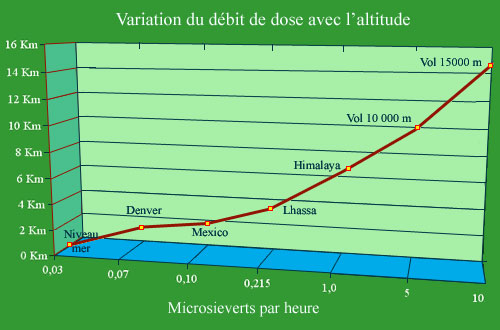
Effects of altitude
Exposure to cosmic rays, measured by the dose rate, increases with altitude. The dose rate is measured here in microsieverts per hour (one microsievert, or one thousandth of a millisievert). As an indication, the average exposure dose from natural radioactivity is 4,500 microsieverts per year, or 4.5 millisieverts per year.
© IRSN
All these particles – gamma rays, muons, electrons, neutrinos – constitute a source of radiation. The flux of these cosmic particles (excluding neutrinos) in France is 240 per m2 per second at ground level.
The intensity of this flux and of cosmic radiation increases with altitude, as the protective effect of the atmosphere decreases as altitude increases. The atmosphere acts as a shield against cosmic radiation: exposure doubles at 1,500 m compared with sea level and increases even further during travel at high altitude.
The highest cosmic-ray dose rates are received by cosmonauts during space flights (0.8 mSv per day on average). During an airplane journey at an altitude of 8,000 metres, the dose received is nearly 100 times greater than at sea level. Even though this dose remains relatively low (a passenger on a London–New York flight receives a dose of 0.032 mSv, the equivalent of a panoramic dental X-ray), this warrants monitoring for frequent travellers and aircrew (who are now considered workers exposed to ionising radiation).
Even without flying, we receive doses that depend greatly on where we are. In the first few kilometres of the atmosphere, the radiation level doubles every 1,500 metres. Thus, people living in the Andes and Tibetans in the Himalayas receive four times more exposure to cosmic radiation than people in Paris, London or New York.
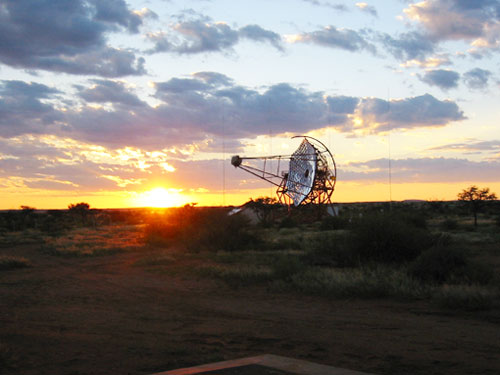
Large telescopes in the Namibian desert
Cosmic rays strike the Earth both night and day, but to observe the fleeting flash of Cherenkov light triggered by a cosmic shower, it is necessary to move away from all human installations, wait for nightfall and avoid the Moon. This large telescope from the HESS experiment prepares to record data as the Sun sets over the savannah of a plateau in Namibia.
© HESS/LPNHE
Annual exposure at sea level corresponds to a dose of 0.27 mSv. This takes into account the limited protection provided by buildings. An individual’s exposure depends on the altitude at which they live and the frequency of their air travel. Average exposure in France is approximately 0.30 mSv.
Finally, the bombardment of atoms in the atmosphere produces a small quantity of radioactive elements. This is how radioactive carbon, carbon-14, is generated during an interaction between a neutron from a cosmic shower and the nucleus of a nitrogen atom in the air.
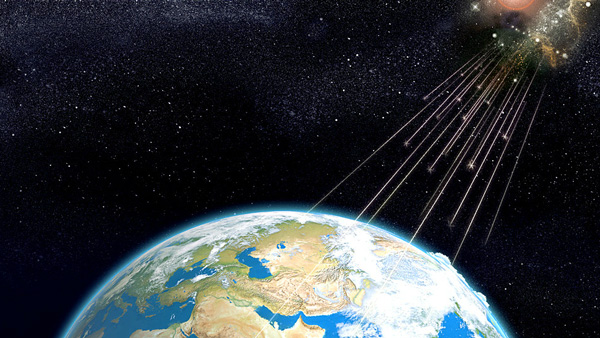
Des particules cosmiques de très haute énergie Des particules de très haute énergie en provenace de notre galaxie et de galaxies lointaines atteignent la Terre. Elles sont étudiées par des expériences au sol ou embarquées sur des satellites. Quand elles frappent les couches supérieures de l’atmosphère, elles génèrent des gerbes cosmiques. Même si ces gerbes n’ont pas l’ampleur de celle dessinée par l’artiste, leur détection au sol nécessite des dispositifs occupant une surface considérable comme ceux de l’expérience HESS. Cosmic rays – 100 years of discovery
Study of cosmic radiation and Astroparticles
The origin of cosmic rays has been the subject of extensive research since their discovery in 1912 by Victor Hess (who would receive the Nobel Prize in 1936). Today, the study of very high-energy cosmic showers provides valuable information about the origin of particles coming from our galaxy or more distant galaxies, created and accelerated during the most violent phenomena in the Universe and which sometimes reach us after a journey of several billion years. This is the subject of the science of astroparticles, a new discipline of astronomy that has been developing rapidly in recent years.