


Eliminating bacteria, molds and parasites ….
Editorial review 2026
Gamma irradiation is used industrially in food hygiene. Around 20,000 tonnes of food products are sterilized each year in France by gamma irradiation or by accelerated electrons. Since 2010, an average of 6,500 tonnes of foodstuffs, mainly frog legs and dried aromatic herbs, spices and vegetable condiments, have been ionized in Europe, although this quantity tends to decrease.
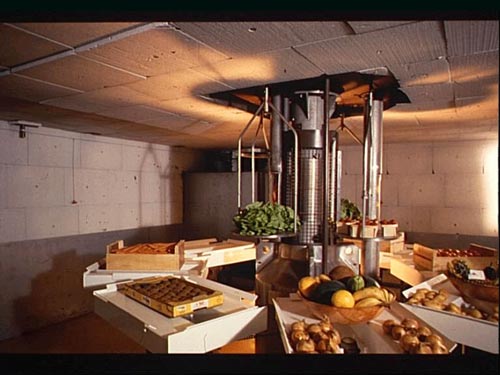
Irradiator
Irradiator of the “Gamma Food Irradiation Center” installed at the Cadarache Research Center and intended for experimental work. It was designed to process fresh plant products. It is also used for the development of irradiation processes for non-food products. This irradiator is the size of small industrial installations.
CEA

Irradiation symbol: on all products sterilized by gamma irradiation, this small logo should appear. In practice, this labeling is almost never seen by consumers because irradiated ingredients are most often incorporated into prepared meals where they are mixed with other non-irradiated ingredients. (
Such radiation is an ideal tool for eliminating, at low temperature and with great reliability, microorganisms, bacteria, molds and parasites.
During the operation, only atoms and molecules are affected by the radiation. Irradiation does not affect atomic nuclei, unlike what would happen with neutrons. Moreover, the effects cease at the end of the operation. No radioactive element is produced. From this point of view, the consumption of food sterilized by this process presents no danger.
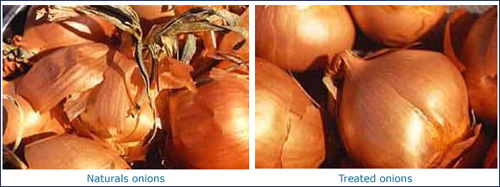
Inhibition of onion sprouting
Low doses of cobalt-60 irradiation (from 40 to 100 grays) effectively control the sprouting of bulbs such as onions. The treated onions (right) do not show the signs of sprouting seen in untreated onions of the same age (left).
© CEA
However, controversies persist regarding the possible creation of toxic substances. The European Food Safety Authority (EFSA) did not consider conclusive the results of studies tending to demonstrate the mutagenic or carcinogenic nature of food irradiation, but it questions the neurological disorders observed in cats fed with highly irradiated food.” (IRSN).
The effects depend on the irradiation dose expressed in grays (Gy). It is possible to inhibit sprouting (40 to 100 Gy), sterilize insects (30 to 200 Gy), or kill them (1,000 to 3,000 Gy). Higher doses are required to eliminate microbes (1,000 to 4,000 Gy), destroy pathogenic germs (1,000 to 6,000 Gy), or achieve complete sterilization (15,000 to 50,000 Gy).
Many countries authorize the marketing of these irradiated products. Others oppose it, as the association between food and radioactivity may worry poorly informed consumers. In France, around thirty authorizations exist.

Obtaining beautiful fruits …
A little-known application of radioactivity is the eradication of harmful insects. The technique consists in irradiating male larvae so that they cannot produce offspring. In the agri-food industry, this method has helped combat the medfly, which devastated harvests in fruit- and vegetable-producing countries. The method is harmless. Gamma rays do not generate radioactivity, and it is the flies, not the fruits, that are irradiated.
© IAEA and Biofly/Ilan Misrahi
In another field, gamma rays help produce beautiful fruits and vegetables by eradicating flies that destroy crops in sunny countries. Larvae of these insects are irradiated to make them sterile. Once adults, these released flies produce no offspring when they mate with wild flies. There is no longer any need for insecticides to combat these pests. There is no danger of radioactivity either. The method is clean and biological.
See also:
Food preservation
Other articles on the subject « Applications of Radioactivity »
Inspection and controls
A Tool for Inspections and Adjustments Editorial review 2026 The penetrating nature of rad[...]
Material Developmnent
Improving the quality of industrial products Editorial review 2026 Every day, we use products who[...]
Non Destructive Testing
Monitoring without causing damage … Editorial review 2026 Radioactive tracers and sources are use[...]
Food processing
Eradicate bacteria, fungi and pests with radiation … Gamma rays are used industrially to en[...]
Medfly Eradication
The Medfly scourge and its eradication Editorial review 2026 Mediterranean fruit flies, or[...]
Disinfecting Effects
Getting rid of parasites and microbes… Editorial review 2026 The radiobiological action of [...]
Radioactive Gauges
Instruments for monitoring industrial processes Editorial review 2026 Modern industry, in [...]
Sources in Industry
A wide variety of applications Most of the radionuclides contained in radioactive sources are ext[...]
Various Applications
From Environmental Monitoring to Oil Exploration … Editorial revision 2026 Because of the f[...]