


Our bodies are also… slightly radioactive
Editorial revision 2026
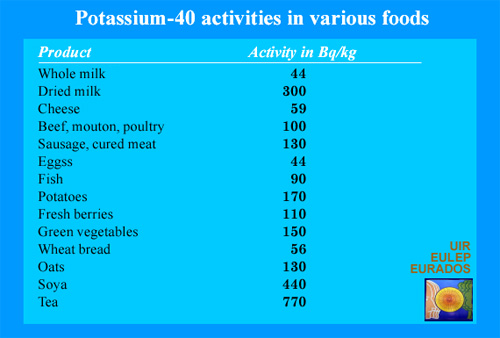
Potassium 40 in food products
Potassium is present in all foods. It would therefore be pointless to try to reduce the activity caused by potassium-40 by avoiding, for example, soy or tea, because our bodies need potassium, and this need is regulated by metabolism. The same applies to the activity caused by carbon-14, which is present in the air, plants, and living organisms. Moreover, since the becquerel (Bq) is an extremely small unit, activities of around a hundred becquerels per kilogram pose no danger.
© IN2P3 (Source K.G.Gerber/Unscear)
More than half of internal radiation comes from potassium-40, which enters the human body through ingestion. The human body also contains carbon-14. In total, about eight thousand potassium-40 and carbon-14 atoms decay every second in the body of a person weighing 80 kilograms: we ourselves are radioactive.
Potassium-40 and carbon-14 atoms mainly emit beta particles, which are absorbed locally and are responsible for internal exposure. The decay of potassium-40 also produces 11% gamma rays, which can be detected outside the human body.
Primordial radionuclides and their decay products found in terrestrial rocks are present in trace amounts in drinking water and plants, resulting in internal exposure through ingestion. This may be compounded by exposure through inhalation after these radionuclides are resuspended in the air as dust.
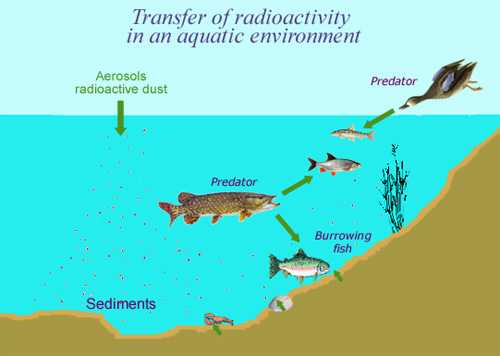
Concentration Through the Food Chain
This example shows how natural radioactivity makes its way to humans through the food chain. Gaseous radon atoms transform after a few days into lead-210 atoms, which attach to aerosols and fall back to the Earth’s surface as a fine deposit. Atoms that end up in water or sediments have plenty of time – their half-life is 22.3 years – to enter the organisms of living beings. Marine organisms concentrate lead-210, which transforms into polonium-210: 50,000-fold in crustaceans,10,000-fold in mollusks, 2,000-fold in fish. Because polonium-210 is an alpha emitter, consuming 10 kg of mollusks and crustaceans per year can result in a dose of 3 mSv.
© IN2P3 et al.
Through regulatory mechanisms, the amount of naturally occurring potassium in the human body is independent of the amount ingested. The same applies to carbon-14.
These regulatory mechanisms do not exist for radionuclides in the uranium and thorium decay chains. Consequently, the doses received depend on the amounts ingested.
Of all the heavy elements derived from uranium or thorium, lead-210 contributes the most to internal exposure. It is incorporated through inhalation and, above all, through ingestion. Uranium-238, together with its two decay products, thorium-234 and protactinium-234, as well as uranium-234, is mainly incorporated through ingestion and accumulates primarily in the kidneys and bones. Thorium-230 and thorium-232 enter the body mainly through the lungs (inhalation). Their decay products, radium-226 and radium-228, are present in food.
The presence in our bodies of all these naturally occurring radioactive elements results in an average exposure of approximately 0.25 millisieverts (mSv) per year, or about 10% of exposure to natural radioactivity.
Other articles on the subject « Natural Radioactivity »
Natural Origins
From Remnants of the Earth’s Formation to Cosmic Rays 2026 Editorial Revision Humans have a[...]
Uranium and thorium origins
Radioelements as old as the Earth and their descendants Editorial revision 2026 The main source o[...]
Cosmogenic Radioelements
The Formation of Radioelements from Cosmic Rays 2026 Editorial Revision The Earth is constantly b[...]
Natural Exposure
A chronic but benign exposure All exposure to radioactivity, whether natural or artificial, is me[...]
Ground Radioactivity
Terrestrial Exposure or Radioactivity Emanating from the Ground 2026 Editorial Revision The Earth[...]
Radioactivity in food
In our glasses and on our plates… Editorial revision 2026 It is impossible for us to escape[...]