


The Formation of Radioelements from Cosmic Rays
2026 Editorial Revision
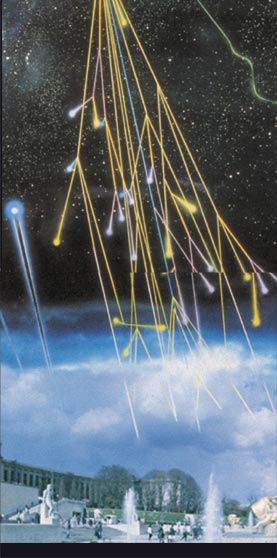
Gerbes cosmiques Une particule cosmique primaire qui pénètre dans l’atmosphère de la Terre génère une pluie de particules secondaires à la suite d’une cascade de collisions avec les noyaux d’azote et d’oxygène de l’air. Parmi ces particules secondaires certaines atteignent le sol. Nous sommes traversés depuis toujours par ce bombardement quotidien, représenté ici au dessus des jardins du Trocadéro à Paris. Le rayonnement cosmique contribue à la radioactivité naturelle à laquelle nous sommes exposés. INFN/IN2P3
The Earth is constantly bombarded by “cosmic rays”, very high-energy particles originating from galactic space. These particles (known as primary particles) may be electrically charged or neutral. Charged primary particles consist of 86% protons, 13% alpha particles, and a small proportion of heavier nuclei. Neutral primary particles are gamma-ray photons or neutrinos.
The energy of cosmic rays varies enormously. The inhomogeneous magnetic fields of stars, which act as accelerators, can impart energies of more than one billion electronvolts to some charged cosmic particles. When these particles reach the vicinity of the Earth, they are deflected by the Earth’s magnetic field, which acts as a shield. Near the poles, this protection is less effective: high-energy cosmic rays are responsible for the aurora borealis.
When they enter the upper layers of the atmosphere, cosmic rays collide with atomic nuclei, whose fragments in turn strike other nuclei. This cascade of collisions produces a shower of secondary particles, some of which reach the Earth’s surface, such as muons (particles related to electrons, 200 times heavier and unstable) and neutrinos.
During the development of the shower produced by the primary cosmic ray, however, the nuclei of atmospheric atoms that served as targets may be broken apart, releasing protons and neutrons. These neutrons can penetrate the nuclei of other atoms and make them radioactive. These radioactive nuclei, produced as a by-product of cosmic radiation, are called cosmogenic nuclei. The phenomenon was demonstrated by the French physicist Pierre Auger.
During the development of the shower produced by the primary cosmic ray, however, the nuclei of atmospheric atoms that served as targets may be broken apart, releasing protons and neutrons. These neutrons can penetrate the nuclei of other atoms and make them radioactive. These radioactive nuclei, produced as a by-product of cosmic radiation, are called cosmogenic nuclei.
This is how one of these neutrons, when it enters the nucleus of a nitrogen atom in the air, can trigger the ejection of a proton or of a proton bound to two neutrons (tritium). In the first case, the nitrogen is transformed into radioactive carbon-14; in the second, it is transformed into stable carbon accompanied by radioactive tritium.
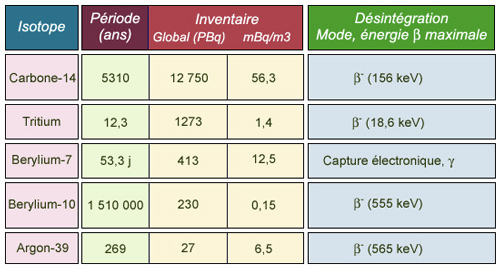
Main Cosmogenic Elements
Carbon-14 and tritium are the main elements generated by cosmic radiation. The inventory corresponds to the total activity in the atmosphere estimated on a global scale (1 PBq equals 1 million gigabecquerels). Some of the carbon-14 is absorbed by plants, while tritium is incorporated into water. Activities are on the order of a few millibecquerels per cubic metre of air.
© IN2P3 (Source: K. Gerber course)
The main cosmogenic nuclei created in this series of collisions are carbon-14, tritium, beryllium-7 and beryllium-10. Some disappear rapidly. Others persist for a long time, such as carbon-14. Carbon-14 is then absorbed by plants in the same way as ordinary carbon: it can be found in trace amounts in plants and living organisms.
Other articles on the subject « Natural Radioactivity »
Natural Origins
From Remnants of the Earth’s Formation to Cosmic Rays 2026 Editorial Revision Humans have a[...]
Uranium and thorium origins
Radioelements as old as the Earth and their descendants Editorial revision 2026 The main source o[...]
Natural Exposure
A chronic but benign exposure All exposure to radioactivity, whether natural or artificial, is me[...]
Ground Radioactivity
Terrestrial Exposure or Radioactivity Emanating from the Ground 2026 Editorial Revision The Earth[...]
Human Internal Exposure
Our bodies are also… slightly radioactive Editorial revision 2026 More than half of interna[...]
Radioactivity in food
In our glasses and on our plates… Editorial revision 2026 It is impossible for us to escape[...]