


Radioactive air pollution after a major accident
Editorial review 2026
During a major nuclear accident, radioactive products are released into the atmosphere as a result of an explosion, a fire, or because of their volatile nature. Some, such as krypton-85 and xenon-133, noble gases with no chemical affinities, will dilute in the large volume of the atmosphere and will have little effect (spent nuclear fuel reprocessing operations also release krypton-85). Others will attach themselves to fine particles – aerosols – or to water vapour. The best known are the radioactive isotopes of iodine (iodine-131, 132 and 133) and caesium (caesium-137 and 134). These radionuclides will become part of a radioactive plume which, rising in altitude, will transform into a cloud that will travel and disperse according to winds and weather conditions.
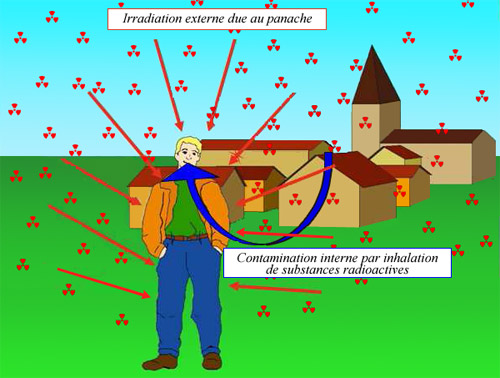
Atmospheric releases: contaminated air
The presence of radioactive particles in ambient air causes external irradiation as well as internal contamination through inhalation. External irradiation is mainly due to gamma rays. Doses from internal contamination are mainly due to alpha and beta radiation. Internal contamination is mainly caused by alpha and beta radiation. Radioactive particles present in the air are mobile and their effects will only last for the duration of their passage, unlike the fraction that settles on the ground and contaminates it over the long term. © IRSN
The radioactive particles in the cloud emit radiation capable of reaching the ground and populations. They are responsible for external exposure due to gamma rays, because beta rays and especially alpha rays are stopped after travelling only a short distance through the atmosphere. This external exposure is temporary and lasts only for the time during which the particles pass nearby. Furthermore, if the particles belong to a radioactive plume travelling at altitude, the radiation will be reduced by the distance and the shielding effect of the air.
This is why long-lived radioactive residues dispersed during nuclear tests in the 1960s are still found in the troposphere and stratosphere, where they have been circulating around the Earth without reaching us.
It should be noted that the passage of a radioactive cloud can hardly itself be the cause of cancers due to external exposure. Furthermore, gamma rays coming from the cloud do not target one organ more than another.
As an illustration, the thyroid, which represents a tiny fraction of the volume of our body, does not attract gamma radiation more than other organs. Similarly, gamma rays cannot wilt flowers on a balcony, as was claimed by a listener at the time of the passage of the Chernobyl cloud.
The effects of gamma radiation take much longer than a single night to appear and … to wilt flowers. However, if radioactive particles are present in ambient air, they can be inhaled. The dangers of internal irradiation resulting from this inhalation are much greater. Once the radioactive product has been inhaled, it can become fixed in a target organ, such as iodine in the thyroid. Possible protective measures include wearing masks, staying indoors and, where appropriate, filtering the air.
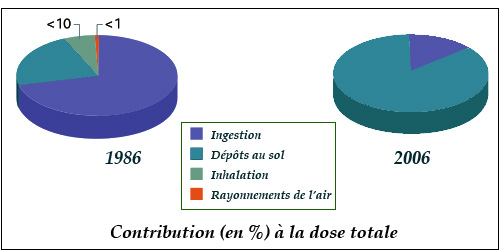
Exposure pathways
According to IRSN, food contamination was the main source of exposure following the Chernobyl accident in France in 1986, followed by radiation from deposits on the ground. Exposure pathways due to inhalation and radioactive particles in the air represented less than 10% (close to the accident site, these proportions were higher). Twenty years later, in 2006, exposure, which had greatly decreased, was dominated by ground deposits. © Source: IRSN Chernobyl booklet, 2006
Unlike exposure resulting from deposits on the ground, exposure from atmospheric releases is by nature temporary. Protective measures are necessary during the peak of pollution. Dilution and dispersion in the atmosphere, deposition on the ground and on the surface of vast and deep oceans, combined with the effects of radioactive decay, reduce over time the exposure and the risk it represents.
Other articles on the subject « Accidental Releases »
Atomic bombs legacy
The distant legacy of the Cold War Editorial review 2026 A legacy of the Cold War and the [...]
Risks of ground deposits
The two modes of deposition: dry and wet deposition Editorial review 2026 In everyday life, away [...]
Risks of Internal Exposure
After an accident: What impact on food and humans? Editorial review 2026 A large amount of radioa[...]
Exposition modes (accident)
What are the exposition pathways after a major accident ? Editorial revision 2026 What is the imp[...]