


The key to the enigma: neutrino metamorphoses
Editorial review 2026
Neutrinos are subject only to weak interactions. There are 3 species: the electron-neutrino associated with the electron; the muon-neutrino associated with the muon, a heavy and unstable analogue of the electron; and the tau-neutrino associated with the tau, a particle even heavier and more unstable than the muon. Their masses are similar and close to 0. The three species are distinct when they are produced.
Weak interactions possess many peculiarities, fascinating to those who study them. To explain the observed deficit of solar neutrinos, physicists came up with the idea that neutrino species could transform into one another over time. Neutrinos would oscillate. Thus, a solar neutrino born as an electron-neutrino in the Sun may have become a muon-neutrino or tau-neutrino by the time it reaches Earth.
The neutrinos produced in the Sun are electron-neutrinos capable of interacting in terrestrial detectors. The two other neutrino species – muon-neutrino and tau-neutrino – interact very little.
The hypothesis of neutrino oscillations was proposed, notably during work carried out in 1999 by the Kamiokande experiment near Tokyo led by Masatoshi Koshiba. If during the 8 minutes that solar neutrinos take to travel from the Sun, a significant fraction of them transforms into muon or tau neutrinos escaping detection, correspondingly fewer interactions will be observed.
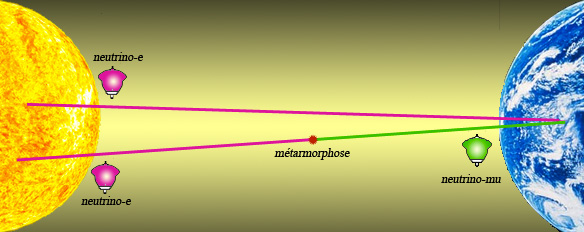
Neutrino metamorphosis
Two electron-neutrinos produced in the Sun travel through space to reach a neutrino observatory on Earth. The first one (colored pink) is still an electron-neutrino when it passes through the observatory and is detected there. During its journey, the second transforms into a muon-neutrino, another neutrino species (colored green) which is not detected by the observatory. The transformations of neutrino species into one another lead to a deficit in the observed electron-neutrinos. © IN2P3
It remained to verify that this oscillation phenomenon proposed by theorists was indeed real. Confirmation came from data collected between 1999 and 2006 by the Sudbury Neutrino Observatory (SNO), an observatory built in Ontario, Canada, more than 2000 meters underground. An impressive cavern houses the detector composed of 1000 tonnes of heavy water enclosed in an acrylic plastic vessel surrounded by very pure ordinary water; 9,600 photomultipliers detect the small cones of Cherenkov light emitted by electrons propelled during a collision with neutrinos.
Thanks to heavy water, the experiment evaluated the total number of solar neutrinos and not only the number of electron-neutrinos as previous experiments had done. A particular reaction involving the deuterium nuclei in the target made it possible to detect all three neutrino species. (NB: the SNO experiment exploits the only interaction mode available to muon-neutrinos and tau-neutrinos, elastic collision with an electron). By summing the three species, the deficit compared with expectations disappeared.
The results established that part of the solar electron-neutrinos were indeed transforming into muon and tau neutrinos during their journey toward Earth. The mystery of the solar neutrino deficit had found its solution.
In October 2002, the Nobel Prize in Physics was awarded to Raymond Davis and Masatoshi Koshiba, the two pioneers of this nearly forty-year exploration, and through them to all those involved in this persistent research. Thirteen years later, the 2015 Nobel Prize in Physics was awarded to Japanese and American researchers Takaaki Kajita and Arthur B. McDonald for their work demonstrating neutrino oscillations, also confirming that these particles possess mass.
TV7 – The journal guest …
Interview on TV7, a local Bordeaux television channel, with Frédéric Perrot on the occasion of the 2015 Nobel Prize in Physics awarded for work on neutrinos. A lecturer-researcher at the Bordeaux Gradignan Nuclear Studies Center, Frédéric Perrot is a specialist in neutrinos.
CONTINUED: Solar neutrinos
SEE ALSO