


From Environmental Monitoring to Oil Exploration …
Editorial revision 2026
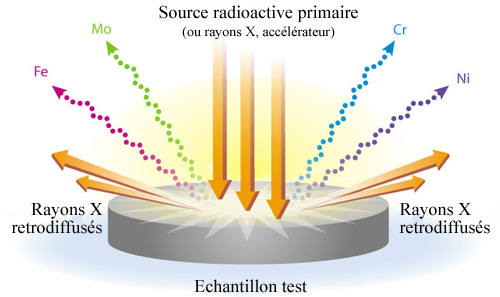
Steel inspection by X-ray fluorescence
A steel sample whose composition is to be checked is bombarded with a radioactive source. As the rays penetrate inside the sample, they excite the inner shells of the atoms present in the metal, causing the emission of characteristic X-rays. Some of these rays emerge from the surface and can be detected. In the example shown in the figure, X-rays from molybdenum (Mo), chromium (Cr), and nickel (Ni) are identified alongside the dominant iron signals.
© DR
Because of the fears it inspires, radioactivity is considered in the collective imagination as hostile to the environment. Yet, when properly controlled, it contributes to improving it through valuable monitoring systems.
One example is the monitoring of air quality and dust content in industrial emissions. To measure the level of dust resulting from these emissions, the air is continuously filtered on a moving strip placed between a radioactive source and a detector. The intensity of the radiation received by the detector depends on the dust concentration on the filter, making it possible to determine this level and take the necessary measures if the dust concentration becomes too high.
Radioactive gauges play a similar watchdog role in the coal industry, which still accounts for more than half of global electricity production. Some neutron-emitting gauges (generally using americium-241 and beryllium) measure and monitor the moisture present in coal and coke. Others, which emit gamma rays, are used to verify the composition of ash and combustion gases released from chimneys. It is important to limit the amount of sulfides and nitrides present in these gases and ashes because of the harmful role these contaminants play in acid rain.
More generally, and beyond environmental considerations, it is necessary in many industrial processes to determine the composition of minerals or materials used in manufacturing products. The property of X-ray fluorescence (the emission by atoms of characteristic X-rays under the effect of radiation) is often used for this purpose. This makes it possible to guarantee the consistent quality of a steel coating or to monitor the proper progress of a chemical process. A combination of radiation filters is sometimes used to sort X-rays and facilitate the identification of atoms present in a complex mixture of minerals or components.
Radioactive sources are used as diagnostic tools during refining operations, which constitute a major part of the oil industry. Since it is difficult to install and maintain probes inside distillation towers because of the extreme conditions prevailing there, gamma probes can be installed outside the towers and moved vertically to monitor liquid levels inside, record the composition of ingredients at various heights, and detect malfunctions.
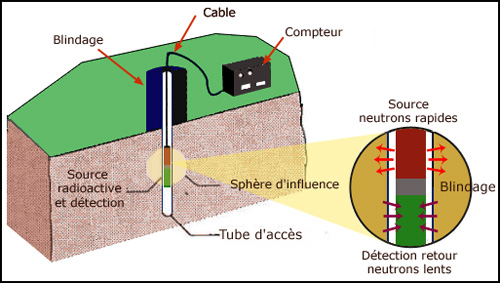
Detection of moisture and hydrocarbons
Water and hydrocarbons are rich in hydrogen, whose nucleus is the most effective neutron moderator. To detect the presence of hydrogen in soils, a probe containing a neutron source is inserted into the ground, delivering brief pulses of fast neutrons. Associated with the source is a slow neutron detection device. The abundance of hydrogen-rich materials is measured by the flux of slow neutrons returning to the detector shortly after the pulse.
© Melonou
In geology, and especially in oil exploration, radioactive sources are used to investigate soil properties, measure density, or detect the presence of water or hydrocarbons.
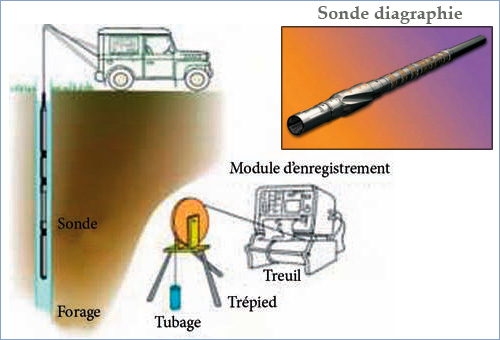
Principle of well logging
Well logging consists of characterizing, after drilling has been carried out, the properties of the rocks encountered using different probes. Some logging techniques use gamma or neutron sources placed in the probe. There are real-time logging methods, where formation characteristics are recorded during drilling (« logging while drilling »). There are also delayed logging methods, where formation characteristics are recorded after drilling. In this case, the measuring instruments are lowered into the borehole (before casing).
© ASN
Well logging allows the study of geological properties of the subsurface by introducing a probe equipped with a gamma source (cobalt-60, cesium-137, etc.) or a neutron source (americium-beryllium or californium-252). In the first case, the gamma backscattering phenomenon is used for density and composition measurements; in the second, neutron slowing-down is used to detect the presence of hydrogen.
Other articles on the subject « Applications of Radioactivity »
Inspection and controls
A Tool for Inspections and Adjustments Editorial review 2026 The penetrating nature of rad[...]
Material Developmnent
Improving the quality of industrial products Editorial review 2026 Every day, we use products who[...]
Non Destructive Testing
Monitoring without causing damage … Editorial review 2026 Radioactive tracers and sources are use[...]
Food processing
Eradicate bacteria, fungi and pests with radiation … Gamma rays are used industrially to en[...]
Agri-food applications
Eliminating bacteria, molds and parasites …. Editorial review 2026 Gamma irradiation is use[...]
Medfly Eradication
The Medfly scourge and its eradication Editorial review 2026 Mediterranean fruit flies, or[...]
Disinfecting Effects
Getting rid of parasites and microbes… Editorial review 2026 The radiobiological action of [...]
Radioactive Gauges
Instruments for monitoring industrial processes Editorial review 2026 Modern industry, in [...]
Sources in Industry
A wide variety of applications Most of the radionuclides contained in radioactive sources are ext[...]