


Loot that is especially dangerous for thieves
2026 editorial revision
While negligence on the part of those responsible for the hospital was at the origin of the Goiânia accident (members of the public were exposed after entering the abandoned premises to recover scrap metal), thefts or losses of radioactive materials periodically make the news.
These materials are not what thieves are looking for, but they sometimes end up as part of their loot, at their own risk. In all these cases, the thieves were primarily interested in stealing the vehicles and were unaware of the dangerous nature of their cargo.
Such thefts have recently occurred in Mexico in connection with illicit trafficking. During the night of Monday 13 to Tuesday 14 April 2015, a container holding an iridium-192 source was stolen from a van near the city of Cárdenas in the Mexican state of Tabasco. Iridium-192, with a radioactive half-life of 74 days, is a powerful emitter of beta and gamma radiation, used in industrial radiography (gamma radiography). Removed from its container and handled without precautions, the source can cause severe burns and may even lead to death within hours or days.
In the event that the stolen material was found, Mexican civil protection authorities urged people “not to approach or handle it”, to notify the authorities and, in the meantime, to establish a thirty-metre safety perimeter. A few days later, on Wednesday 22 April, Mexican authorities announced that the radioactive iridium-192 source had been found “abandoned under a bridge”.
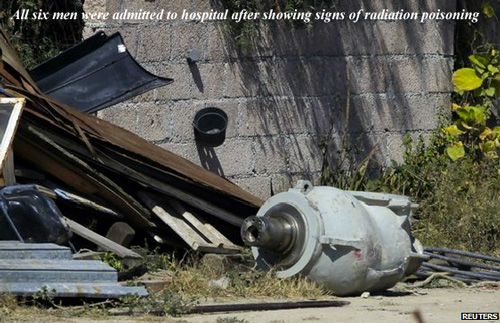
December 2013: abandonment of a cobalt-60 source stolen in Mexico
Container of the cobalt-60 source abandoned during the theft in December 2013 of the truck transporting it. After their arrest, the six men involved were admitted to hospital after showing signs of radiation exposure.
© BBC/Reuters
The theft of the iridium source occurred 16 months after the theft of a 60-gram cobalt-60 source near Mexico City. Cobalt-60 is a powerful emitter of gamma rays that is still used in some hospitals for cancer treatment in what is known as a cobalt bomb. At the end of its useful life, the source was being transported from a hospital in Tijuana, in the north of the country, to a radioactive waste storage facility.
On 5 December 2013, two men attacked the driver of the truck, who had stopped to sleep near a petrol station, and stole the truck and its cargo. The truck was found abandoned in a field two days later, two kilometres away. The radioactive source had been removed from its protective shielding and left 500–700 metres from the truck. Six men aged between 18 and 35 were arrested a few days later.
The thieves probably wanted to find out what the containers held and resell the metal. Their curiosity came at a high price. The prospect of financial gain exposed them to dangerous levels of radioactivity. The six men showed signs of radiation exposure, probably burns, and had to spend time in hospital before being sent to prison.
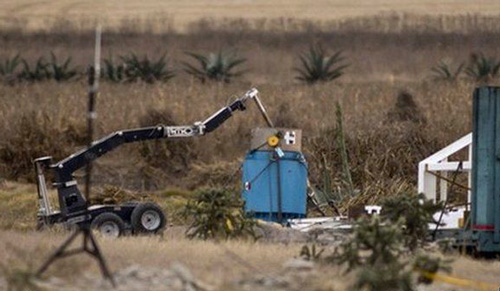
Recovery of the stolen radioactive source
A remotely controlled robot was used to recover the cobalt-60 source that had been removed from its container and make it safe.
© BBC/AP
More frequently, in France, hardly a fortnight goes by without the theft of a lead-paint analyser being reported to the authorities. Here are some recent examples made public on the ASNR website:
- 30 January 2026: theft in Douai. The device contains a cobalt-57 source with a nominal activity of 185 MBq.
- 8 December 2025: theft in Salon-de-Provence.
- 6 November 2025: theft in Évry.
During these various incidents, it was established that the thieves wanted to steal the vehicles and whatever they might contain, without being aware of the dangerous nature of their loot or the risks they were taking. Quickly recovered, the stolen radioactive sources did not result in health consequences, apart from those affecting the thieves and people who approached them before they were discovered.
The 30-metre safety perimeter prevents any contact with the source. As for the risk from gamma rays, at this distance, for a source emitting equally in all directions, approximately one gamma ray out of every 10,000 emitted is capable of reaching a target with a surface area of 1 m2, roughly equivalent to that of a human being. Furthermore, not all photons reaching an individual necessarily interact with the body. Therefore, if the sources are quickly located and recovered, population exposure and its consequences are very limited. It should be remembered that the number of gamma photons received varies inversely with the square of the distance between the individual and the source: for example, increasing the distance from 1 to 2 metres reduces by a factor of 4 the number of photons that may be received. If there is any doubt about the nature and activity of a radioactive source, moving away from it remains the best first precaution to take.
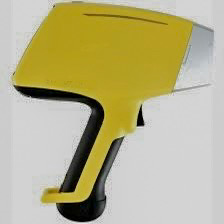
Photo of the lead analyser.
The person stealing it probably does not realise that there is a radioactive source inside the device.
At 30 centimetres from the source, for an activity of 185 MBq, the equivalent dose rate is 46 µSv/h.
Even if the symbol is not widely recognised by the general public, would it not be useful to add a yellow triangle with a black background to indicate the presence of radioactivity? The photo shows no such symbol. Image credit: Zeuserdoo, CC0 1.0, via Wikimedia Commons.
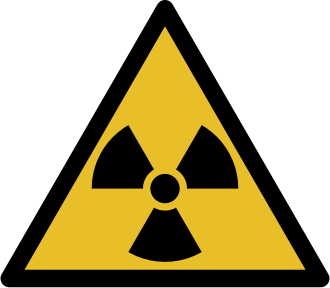
Internationally recognised symbol. Warning sign for ionising radiation.
During the incidents in Mexico, it was established that the thieves wanted to steal the vehicles and whatever they might contain, without being aware of the dangerous nature of their loot or the risks they were taking. Quickly recovered, the stolen radioactive sources did not result in health consequences, apart from those affecting the thieves and people who approached them before they were discovered.
The 30-metre safety perimeter prevents any contact with the source. As for the risk from gamma rays, at this distance, for a source emitting equally in all directions, approximately one gamma ray out of every 10,000 emitted is capable of reaching a target with a surface area of 1 m2, roughly equivalent to that of a human being.
Furthermore, not all photons reaching an individual necessarily interact with the body. Therefore, if the sources are quickly located and recovered, population exposure and its consequences are very limited. It should be remembered that the number of gamma photons received varies inversely with the square of the distance between the individual and the source: for example, increasing the distance from 1 to 2 metres reduces by a factor of 4 the number of photons that may be received. If there is any doubt about the nature and activity of a radioactive source, moving away from it remains the best first precaution to take.
Find out more: Article published in Le Monde
NEXT: Space accidents