


Radiation exposure in space
Editorial review 2026
Risks similar to those encountered in aircraft exist for astronauts, but they are poorly understood. Around the Earth, astronauts are protected by the protective magnetic field, which deflects cosmic radiation particles back into space, and by the shielding of their spacecraft when they are not outside in space. This shielding is sufficient to stop a large proportion of the particles produced by solar eruptions, but stopping energetic cosmic particles would require shields several metres thick.
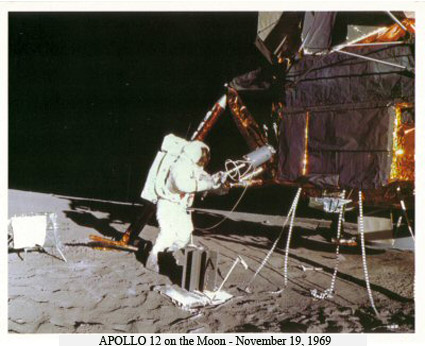
Plutonium 238 on the moon
Generators producing electricity through the radioactive decay of plutonium 238 have been used on all the Apollo moon missions. In the picture above, we see astronaut Alan Bean transferring plutonium 238 stored in a RTG (Radioisotope thermic generator) to the surface of the moon. This plutonium 238 was the main source of energy for experiments conducted on the moon’s surface.
NASA No. MSCL-41
In the case of the Apollo missions, 30 astronauts travelled beyond the Earth’s protective field from 1963 to 1972. Studies of their health have shown that certain symptoms of ageing, such as cataracts, occur approximately 7 years earlier than in other astronauts confined to low Earth orbit.
In another context, spacecraft need long-lasting and reliable energy sources. Many carry powerful plutonium-238 sources on board, whose radioactive decay provides them with the necessary energy, as was the case for the Apollo missions to the Moon.
IRSN video (2013) describing cosmic rays from the Sun, the shield provided by the Earth’s magnetic field, and the risks of exposure during expeditions into space.