


Strict regulations to protect against radiation
Editorial review 2026
Environmental monitoring
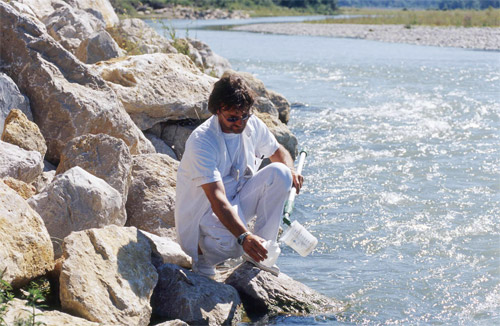
Water samples are taken from the Durance River for analysis near the Cadarache centre, a major CEA nuclear facility. Monitoring the environment around nuclear facilities is part of the mission of radiation protection organisations and services.
© T.Foulon /CEA-CADARACHE
Radiation protection has a long history. It was in 1920, following radiologists’ illnesses, that the International Committee for Protection against X-rays and Radium was founded, the predecessor of the ICRP, the International Commission on Radiological Protection. In 1928, the name was changed, although it would not be officially validated until 1950, to the International Commission on Radiological Protection (ICRP).
Today, few activities are as highly regulated and controlled as the use of radioactive sources and ionising radiation. Radiation protection rules are international. They are issued by organisations and expert committees under the United Nations or the European Union.
In general, the organisations responsible for the safety of nuclear facilities are also responsible for radiation protection. This is the case in France with the Nuclear Safety and Radiation Protection Authority (ASNR), which is responsible for enforcing compliance with radiation protection rules in all fields, providing expertise, analysing risks, carrying out measurements and pursuing research in the field.
The role of this organisation is not only to prevent any accident and release of radioactivity, but also to minimise the impact of nuclear facilities on the environment. The management of waste and effluents from nuclear facilities is subject to specific reinforced regulations.
Reduction of doses at La Hague
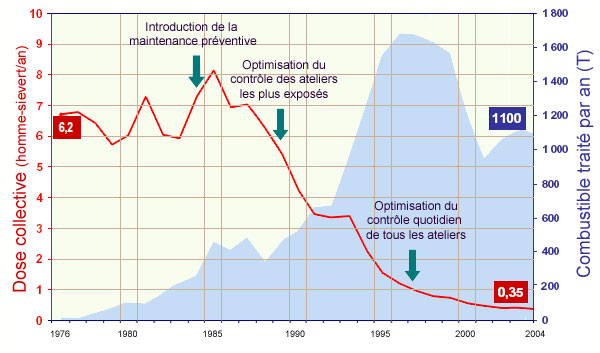
Advances in regulations and efforts by industry have dramatically reduced the doses to which nuclear workers are exposed. Thus, at the La Hague spent fuel reprocessing plant, the collective dose to personnel fell from 6.2 man-sieverts per year in 1976 to 0.35 in 2004, while the plant’s production increased from 0 to 1,000 tonnes. The arrows indicate the main actions that made this reduction possible.
© Areva/ R. Do Quang et P.Baron
Dose limits have been established and have proved effective, both for exposed workers and for ordinary citizens. Thus, in France, the impact of a nuclear power plant is now only 0.005 mSv per year, one thousandth of natural radioactivity or the dose received in 12 hours from natural radioactivity.
Outside nuclear activities, several regulatory provisions contribute to protecting the public against the dangers of ionising radiation in general, particularly in medicine. Thus, in 2024, the ASNR carried out xxxx inspections, conducted in particular in the 180 French radiotherapy centres, which treat 200,000 patients each year. The use of radioactive sources is subject to very strict monitoring and control.
The addition of radioelements to consumer goods and construction materials is prohibited. A few rare exemptions may be granted, after consultation with the relevant ministry (generally the Ministry of Ecology), but never for foodstuffs, cosmetic products, toys and ornaments. This prohibition does not apply to naturally occurring radioelements, such as potassium-40 in milk.
In order to improve the estimation of doses received by the population, a national collection of environmental radioactivity measurements has been undertaken. A monitoring network (National Measurement Network – RNM) brings together the results of these analyses carried out by government services, public institutions, local authorities and associations. The management of this network is entrusted to the ASNR.
For the management of waste and effluents outside the nuclear sector, particularly those from hospitals, general rules have been established. This waste and these effluents are disposed of in authorised facilities, except for radioelements whose decay is sufficiently rapid (radioactive half-life of less than 100 days) to allow them to be monitored on site at the hospital. One example is iodine-131, used in certain thyroid treatments.