


A rare radiation, dangerous, penetrating, difficult to absorb
Editorial review 2026
The neutron radiation is more penetrating than alpha and beta . It is more dangerous than gamma rays. It is fortunately short-lived and rarely encountered. Its exposure is exceptional: intervention in the core of a reactor, critical accident, and at a different scale, exploding atomic bomb or hydrogen bomb (in an hydrogen bomb neutrons are produced through the deuterium-tritium reaction).
Under normal circumstances, exposure is reduced to a few neutrons produced by cosmic radiation. It is very low.
In an atomic explosion, the neutron radiation is particularly harmful. But the neutronic flash does not last. Free neutrons have an half-life of 12 minutes. They are generally absorbed by matters before decaying.
In the 80s, low-power atomic bombs were developed, without blast – so not destructing – but releasing an instantaneous neutron flux of fatal intensity. These « neutron bombs » were intended to annihilate enemy combatants, while allowing to occupy the ground shortly after. The subject of numerous public protests at the time, these weapons have, in principle, been abandoned.
In practice, it is in the vicinity of reactors and accelerators in certain research laboratories that protection against neutrons needs to be implemented because of high neutron fluxes.
Neutrons, slowed down by multiple collisions with the encountered material nuclei, are quickly captured. Generally capture is followed by a de-excitation gamma radiation of which we must be protected. It should also be remembered that part of the captures produced radioactive nuclei. The effects of this radioactivity diluted over time, continue to occur after neutron absorption.
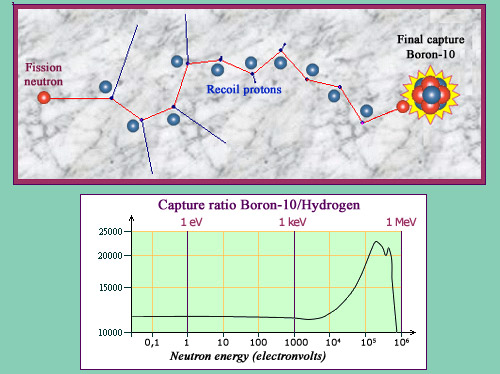
The boron neutron trap
In order to protect against neutron produced in reactors, one add boron to the concrete composition of the surrounding containment walls. The curve shows that the probability of neutron capture by a nucleus of boron-10 (a naturally occurring isotope of boron) exceeds more than 10 000 times that of a hydrogen nucleus. But if ratios barely vary, the boron capture probabilities greatly increase when the neutron slows down. There is sharing of roles: the protons of hydrogen from water slow the neutrons by collisions until they are captured by boron. To make them visible on the upper diagram, protons recoils have been magnified.
© IN2P3 (Source Janis data base)
Neutrons eventually end up being captured by nuclei. To protect against them, the most effective method is to promote these captures by incorporating nuclei with a very high affinity for neutrons, such as boron-10 or cadmium, into the shielding material. The capture probabilities for slow neutrons become very high for these neutron-hungry nuclei, which could be compared to a kind of goalkeeper with tentacle-like arms.
For external protection, neutron shielding is provided by concrete walls containing boron. Concrete contains water, and therefore hydrogen, which effectively slows down neutrons. The boron incorporated into the concrete of the enclosures contains 20% boron-10, which is very effective at capturing neutrons. For slow neutrons, this nucleus appears 60 times larger than it actually is.
The probability (or cross section) of slow-neutron capture by boron-10 is 3,800 barns. By comparison, the fission cross section of uranium-235 nuclei is 650 barns (1 barn = 10⁻²⁴ cm²).
For reactor control rods, cadmium is used, a metallic element whose capture probability of 2,000 barns is 200 times that of iron (10 barns).
In the case of fissile materials, precautions must be taken against the risk of criticality, that is, the unexpected development of chain reactions. For example, in storage pools, spent fuel assemblies that still contain 1% fissile uranium are spaced apart and placed in borated steel racks.
Other articles on the subject « Radioprotection »
Radioprotection principles
Applying common sense rules according to radiation nature Editorial review 2026 The need for prot[...]
Gamma Radioprotection
Penetrating radiation, difficult to absorb Editorial review 2026 Gamma rays are much less dangero[...]
Gamma Absorption
Heavy materials for the absorption of gamma rays In terms of radioprotection mitigate gamma rays [...]
Radioactive Decontamination
Avoid all contact, ingestion and inhalation Editorial review 2026 One of the tasks of radiation p[...]
Justification and optimisation
In medicine, use of radiation must be justified Editorial review 2026 The ‘Justification an[...]
Reglementations and controls
Strict regulations for an efficient radioprotection Radioprotection has a long history. Its princ[...]
Dose legal limits
An application of the precautionary principle: prudent legal limits Editorial review 2026 French [...]
Actors in radioprotection
The actors and the basics of radioprotection regulations The rules of radiation protection are no[...]