


An application of the precautionary principle: prudent legal limits
Editorial review 2026
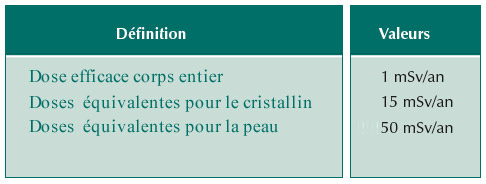
Annual exposure limits excluding natural radioactivity and medicine
These annual exposure limits for the population are established by the Public Health Code. These limits apply to the sum of effective or equivalent doses received excluding natural radioactivity and medicine, including those resulting from nuclear activities. The maximum permissible dose of 1 mSv per year represents approximately 40% of natural exposure. (For the skin, this is the average dose per cm2, regardless of the surface area exposed).
© ASN
French regulations set the maximum permissible effective dose resulting from human activities, excluding natural radioactivity and doses received in medicine, at 1 millisievert (mSv) per year. These are « whole-body doses« . For exposure of an organ or tissue, equivalent doses are considered. Thus, the equivalent dose limits for the lens of the eye and the skin are set at 15 mSv/year and 50 mSv/year respectively.
The limit of 1 mSv/year applies to the general public. It can be compared with the average exposure excluding natural radioactivity and medical exposure, which is 0.060 mSv/year in France, of which exposure from nuclear activities, which concerns the public, represents only a part.
For people who work with ionising radiation, European regulations set a limit of 100 mSv over a period of 5 consecutive years, with the maximum recommended by these regulations for a single year being 50 mSv. French regulations impose a stricter limit of 20 mSv over twelve consecutive months for the exposure of people regularly working in regulated areas (category A). For comparison, the dose received by a patient undergoing an abdominal CT scan is 17 mSv (depending on the patient).
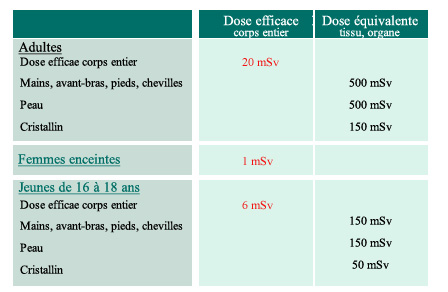
Annual exposure limits for workers
Annual exposure limits for people who may be exposed to radiation as a result of their work, particularly nuclear workers and nuclear medicine personnel. In the case of pregnant women, this refers to the exposure of the unborn child. Previously justified exemptions are permitted in certain work areas for a limited period, subject to special authorisation. These exceptional exposures must not exceed twice the annual exposure limit.
© Source ASN
These limits apply to the annual total of effective doses received. The same applies to the totals of equivalent doses. These limits can, however, be confusing, because the fact that natural and medical exposures are excluded is generally forgotten or omitted.
It should be recalled that the French population is exposed each year to an effective dose per inhabitant ranging from 4.5 mSv to 6.5 mSv. Of these 4.5 mSv, 2.8 mSv comes from natural radioactivity, 1.6 mSv is of medical origin and 0.06 mSv comes from radioactivity related to other human activities, including nuclear activities.
A dose of 1 mSv is considered in radiation protection to be a low, or even very low, dose. The ICRP (International Commission on Radiological Protection) assesses the effects of an exposure of 1 mSv using the linear no-threshold relationship as follows: 1 mSv would cause at most 50 fatal cancers and 13 genetic diseases per million people. These figures should be compared with the 300,000 cancers that will one day affect, from all causes combined, this same million people.
The limit of 1 mSv/year may at first seem much higher than the annual average of 0.06 mSv resulting from human activities once medical exposure is excluded, and even more so than the 0.002 mSv impact of a nuclear power plant.
Furthermore, exposure to natural radioactivity and medical exposure vary considerably from one person to another. These variations, particularly as a result of medical diagnoses and treatments, easily exceed the limit imposed for the third cause of exposure … If the 1 mSv limit were applied to natural radioactivity and medical exposure, it would not be possible to undergo a CT scan, one would have to give up flying, abandon mountaineering, and not live in Brittany or Corsica.
The cells in our bodies do not distinguish between radiation of natural or medical origin and radiation from a nuclear power plant. If fluctuations in exposure from one person to another exceed 1 mSv because of where people live or because of diagnoses or treatments that prolong our lives, it seems artificial to reduce the limit for exposures of the third type, whose role is minor by comparison.
Over the years, legal limits have been greatly reduced. Should they be reduced even further in the name of the precautionary principle? One may question the value of reducing already very prudent limits, given that natural exposures and those due to medical diagnoses are excluded. The effect of low doses has not been proven (except in the case of repeated CT scans in children) and, if it exists, reducing doses of the third type would reduce the number of cancers far less than, for example, improving radiation protection in medical diagnosis.
The principle of limitation in the event of a radiological accident
Finally, exceptional radiation protection measures for the population must be planned in the event of an accident or radiological emergency. Actions and countermeasures are implemented according to the nature and extent of the exposure. In the case of nuclear accidents, intervention levels expressed in terms of doses serve as reference points for public authorities to decide, on a case-by-case basis, which actions to initiate:
– sheltering, if the projected effective dose exceeds 10 mSv;
– evacuation, if the projected effective dose exceeds 50 mSv;
– administration of stable iodine, when the dose to the thyroid is likely to exceed 50 mSv.
Dose reduction and these measures must be weighed against adverse effects. At Fukushima, the evacuation of populations caused trauma. This trauma resulted in more deaths, such as suicides, than those caused by exposure to radioactivity.
With regard to emergency workers in radiological emergency situations, a reference level of 100 mSv has been defined, which must not be exceeded during this type of intervention.
Other articles on the subject « Radioprotection »
Radioprotection principles
Applying common sense rules according to radiation nature Editorial review 2026 The need for prot[...]
Gamma Radioprotection
Penetrating radiation, difficult to absorb Editorial review 2026 Gamma rays are much less dangero[...]
Gamma Absorption
Heavy materials for the absorption of gamma rays In terms of radioprotection mitigate gamma rays [...]
Radioprotection neutrons
A rare radiation, dangerous, penetrating, difficult to absorb Editorial review 2026 The neutron r[...]
Radioactive Decontamination
Avoid all contact, ingestion and inhalation Editorial review 2026 One of the tasks of radiation p[...]
Justification and optimisation
In medicine, use of radiation must be justified Editorial review 2026 The ‘Justification an[...]
Reglementations and controls
Strict regulations for an efficient radioprotection Radioprotection has a long history. Its princ[...]
Actors in radioprotection
The actors and the basics of radioprotection regulations The rules of radiation protection are no[...]