


Widely used dosimeters: simple and reliable
These dosimeters were widely used for many years. In France, they are no longer authorized,
as they proved insufficiently sensitive for low doses after radiation protection regulations
lowered the measurement threshold from 0.2 to 0.1 millisieverts (mSv).
Photographic dosimeters measure the doses received over about two weeks,
resulting from external exposure to beta, gamma, X-rays or thermal neutrons.
Photographic films are sensitive to light, which is itself a form of electromagnetic radiation.
Light transforms, through ionization, silver ions (Ag⁺) dispersed in the gelatin of the film into metallic silver.
Alpha and beta radiations produce the same effect,
making photographic films useful for their detection. However, sensitivities must be adjusted.
The most sensitive films can measure doses as low as 0.1 mSv,
which makes them valuable for monitoring cumulative doses but not instantaneous ones.
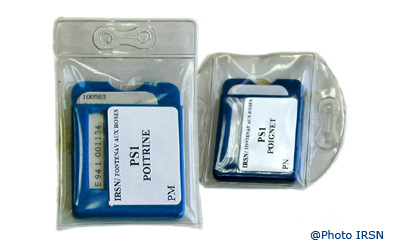
Film badges
Film badges are photographic dosimeters made of photographic emulsions enclosed in a sealed holder or pouch protected by filters.
They are worn on the chest or wrist.
After being developed in a specialized laboratory,
the measurement of the optical density of the emulsions and comparison with calibrated reference films
provides the value of external exposure dose.
© IRSN (Source: Institut National de Recherche et Sécurité)
By placing these films behind a screen composed of several filters of different thicknesses or materials,
one can estimate the energy distribution of the photons that make up the received dose
by comparing the doses measured behind each filter.
The film badge is usually worn at chest height, which generally represents the average whole-body exposure.
In certain cases, occupational physicians may wish to know the dose received at a specific body part (thyroid, gonads, etc.);
an additional badge will then be worn near the organ of interest.
Advantages and disadvantages of film badges
Disadvantages:
– They must be developed, usually monthly due to low sensitivity, so results come with delay; they provide only retrospective monitoring.
– They are sensitive to external conditions (humidity, heat, chemicals) and cannot be stored long before use.
– Sensitivity depends on the number of filters used, making badge processing relatively complex.
Advantages:
– Low manufacturing cost.
– Lightweight and compact, making them suitable for personal use. Standard badges measure about 12 cm² and can be kept for a long time after development.
– When fitted with a cadmium screen, they are sensitive to neutrons.
Use of photographic dosimeters: 2001 document
See also:
Effective dose
External exposures