


Rules for the management of radioactive sources
Editorial review 2026
Industry and research have long used sources of ionising radiation in a wide variety of applications and places of use. Since this radiation is dangerous, radioactive sources cannot be left in just anyone’s hands. Negligence is not an option. When they have reached the end of their useful life, they must not simply be abandoned.
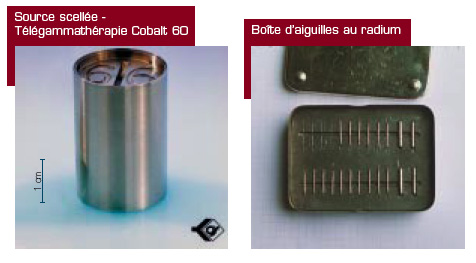
Sealed sources: the case of medicine
The use of sealed radioactive sources in medicine has declined. The powerful cobalt-60 sources used for their gamma rays in radiotherapy have been replaced by accelerators. The main radionuclides used in brachytherapy, caesium-137 and iridium-192, have definitively replaced the radium used in the first half of the 20th century in the form of needles, tubes and probes (more than 3,300 objects have been recovered). The radioactive half-lives of these two elements (30 years and 74 days) are much shorter than the 1,500 years of radium.
© ANDRA
The range of radionuclides present in sealed sources is very varied: Iodine-192, Cobalt-60, Caesium-137, Strontium-90 for short lifetimes; Radium-226, Polonium-210, Americium-241, Curium-244 for long lifetimes (alpha emitters), etc… In terms of numbers, spent sealed alpha sources predominate.
One of the challenges of regulation is to ensure that the safety of workers, the public and the environment is properly guaranteed despite the great diversity of applications. It is important to monitor the conditions under which sources are held, used and disposed of, from their creation — at the manufacturing stage — through to the end of their life.
The use of radioactive sources for research and industrial purposes must be subject to authorisation, except in a few specific cases subject to conditions. The use of radioactive sources for research and industrial purposes must be subject to authorisation, except in a few specific cases subject to conditions. Thus, the possession and use of radioactive sources are subject to authorisation by the Nuclear Safety Authority (ASN) and Radiation Protection (ASNR).
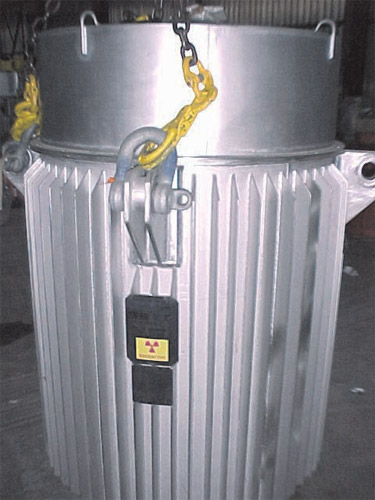
Storage of expired sources
Storage container for spent sources from the CEA and CIS-Bio International. This company has irradiation facilities for biomedical and industrial products. It supplies short-lived radiopharmaceutical products (molecules labelled with a radioactive element). CIS-Bio International stores its spent high-activity sources at the Saclay site, both for itself and for the CEA.
© ANDRA/Cios-bio International
Medicine is subject to separate regulations because tracers are used for diagnostic purposes and the powerful sources formerly used for radiotherapy have been replaced by accelerators that emit radiation only while they are operating.
The marketing of sealed sources used for industrial applications is open to competition. As of 31 December 2002, the Nuclear Safety and Radiation Protection Authority (ASNR) counted 175 distributors. In addition to the requirement for authorisation, regulations governing radioactive sources require users to: register in advance with the IRSN any movement of sources; keep detailed records of sources and their movements; immediately report the loss or theft of a radioactive source to the prefect and the ASN; return expired, damaged or no longer used sealed sources.
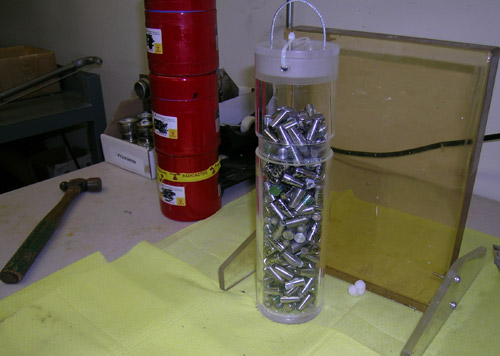
Collection of americium sources in the USA
Tracking down radioactive sources at the end of their useful life is a long-term undertaking. In the United States, this recovery is carried out by the National Nuclear Security Administration. As part of the NNSA’s OSRP (Off-site Source Recovery Project), more than 15,000 of these small americium-241 sources have been recovered. The activity of these tungsten-shielded sources is 150 mCi. After inspection and conditioning, these sources are placed in a special container for storage at Los Alamos while awaiting authorisation for disposal at the Waste Isolation Pilot Plant (WIPP) in Carlsbad, New Mexico.
© LANL
The return of spent sealed sources to the distributor, and then to a manufacturer, is a regulatory obligation to which the user commits at the time of purchase. According to the provisions of the Public Health Code, every user is required to have their suppliers take back sealed sources for which they no longer have any use. The supplier is required to take them back upon simple request.
When renewal applications are submitted, when activities cease or during occasional inspections, the ASNR systematically checks the status and fate of sealed sources.
There is not yet a disposal route for spent sources within the framework of the national plan for the management of radioactive materials and waste, but disposal solutions are being studied. Thus, the ASNR has given its agreement in principle for the disposal, at the Aube disposal facility, of sources considered to be short-lived, with a relatively short half-life of 30 years or less.