


Attenuation of the initial radiation
Editorial review 2026
Of the three modes of radioactivity, gamma radioactivity is the most penetrating and the most difficult to protect against. In theory, it cannot be stopped completely, but only attenuated. In practice, very strong attenuation is equivalent to stopping it, hence the importance of finding effective shielding.
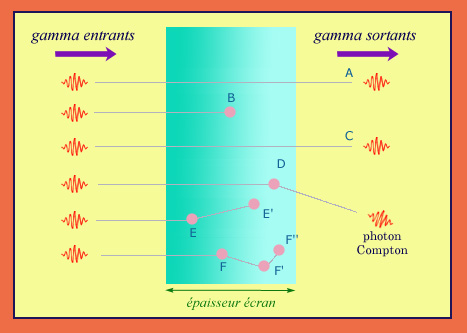
Gamma attenuation
The attenuation of a gamma beam is defined as the fraction of gamma rays that emerge from a shield without having interacted. Of the 6 gamma rays shown (NB: in reality, gamma rays in a beam number in the billions), this is the case for gamma rays A and C. Gamma rays B, E and F are completely absorbed in the shield. Gamma ray D is partially absorbed. It gives rise to a gamma ray (Compton photon) that emerges from the shield with lower energy and in a different direction. These Compton photons must be taken into account when considering absorption.
© IN2P3
In addition to the attenuation provided by a shield, there is the purely geometrical effect of the solid angle, whose protective effect increases with the square of the distance from the source. Since gamma rays are emitted equally in all directions and travel in straight lines, the probability that a gamma ray will strike, for example, a 1 m2 target located one kilometre from the source is very small: 1/12,600,000 (12.6 million m2 represents the surface area of a sphere with a radius of 1 km).
A gamma photon passing through a layer of shielding does not deposit its energy progressively, as an alpha particle does: either it interacts and disappears as such, or it does not interact and nothing happens. In the case of a large number of gamma rays — a beam — a certain number of gamma rays emerge unaffected. The beam is attenuated.
Attenuation is faster when the « probability of interaction » is high. The capacity to attenuate is measured by an attenuation coefficient proportional to this probability, called the cross section. This attenuation coefficient plays the same role as the stopping power associated with energy loss through ionisation for an alpha particle or a beta ray.
In the simple case where all the gamma rays in the beam have the same energy and the shield is homogeneous, a beam will be attenuated in the same way in each elementary layer it passes through. Its intensity decreases with thickness in the same way that the activity of a radioactive source decreases with time, according to an exponential law. A « half-value layer » (or half-thickness) is thus defined, which plays the same role as the half-life in radioactive decay (the intensity is divided by 2 after passing through this thickness).
This characteristic attenuation length varies greatly depending on the nature of the shield and the energy of the gamma ray. This characteristic is often expressed in grams/cm2 (defined as the mass attenuation coefficient) rather than in cm, in order to compare, for equal shielding mass, materials with very different densities, such as lead and water.
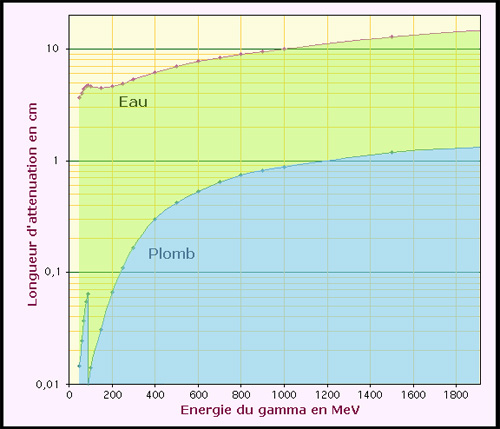
Gamma attenuation: water and lead
A characteristic property of gamma shielding, the attenuation length is the inverse of the attenuation coefficient. The smaller it is, the faster the attenuation. Less than one millimetre of lead is sufficient to attenuate by half a beam of gamma rays with an energy below 200 keV, whereas 5 cm of water is required to obtain the same result. Lead is less effective for energetic gamma rays of 1 MeV: 1 cm is required to attenuate these gamma rays by half (10 cm in water). At this energy, the ratio of the attenuations is close to that of the densities: 11.6 for lead and 1 for water).
© IN2P3 (Sources B.Tamain and K.Gerber)
For the same mass of absorber, water is much more transparent than lead to low-energy gamma rays, but their performances become similar around 1 MeV. Lead is particularly effective at attenuating X-rays and low-energy gamma rays, for which the attenuation length is less than one mm. However, for 1 MeV gamma rays, nearly one cm of lead is required to attenuate them by half.