


Principle and characteristics of Rutherford Backscattering
Editorial review 2026
The principle of the RBS method is that of a small pétanque ball striking a heavy pétanque ball. The small balls are the light ions coming from an accelerator such as AGLAE. The pétanque balls are the heavy nuclei present in the sample to be analyzed. The collision is called elastic. The total kinetic energy and momentum are conserved. The small ball and the pétanque ball remain a small ball and a pétanque ball; the ion remains an ion and the target nucleus remains the target nucleus.
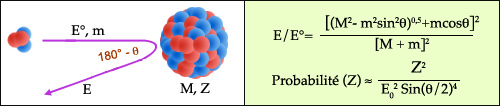
Rutherford Backscattering: two formulas
The RBS method uses two laws of physics. The first one, based on kinematics, provides the ratio between the energy E of the backscattered projectile – proton, deuteron, helium nucleus – and its initial energy E°, as a function of the scattering angle theta. This ratio depends on the ratio between the masses m of the projectile and M of the target nucleus. The second law, due to Rutherford, gives the probability of recoil as a function of the angle. At large angles (close to 180°), this probability varies as the square of the charge of the target nucleus. It is much higher for heavy nuclei than for light nuclei.
© IN2P3/C2RMF
The RBS method consists of counting the number of projectile ions (protons, deuterons, helium nuclei) that bounce back when they are repelled by the electric field of target atoms in the analyzed material. Two formulas make it possible to understand the interest of this backscattering process for identifying the presence of heavy atomic nuclei in a sample.
The first formula results from the application of the fundamental laws of mechanics. During the collision, the kinetic energy and momentum of the projectile-target system are the same before and after the collision. According to these conservation laws, the energy of the ions scattered at a given angle theta (generally chosen in the range of 150-170° relative to the beam direction) has a unique value characteristic of the mass of the target nucleus.
Rutherford Backscattering for heavy nuclei
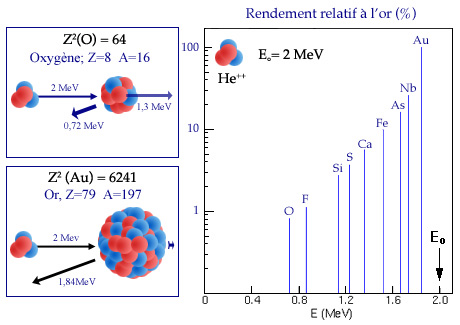
Backward recoil of a 2 MeV alpha particle on an oxygen nucleus (Z=8) and a gold nucleus (Z=79). On the right, values of the energies of the target and projectile after the recoil. The figure on the right compares, in the case of this backward scattering, the recoil energy E and its probability for a series of targets ranging from oxygen to gold (probabilities are compared with gold). It can be seen that the alpha projectile propels the relatively light oxygen nucleus (A=16) further forward than the heavy gold nucleus (A=197), but it loses more energy and recoils less.
© IN2P3
The second formula, due to Rutherford, provides the probability (called the cross section) of scattering at a given angle theta. In the range of angles close to 180° that interests us, this probability is approximated. For a fixed angle and a given initial energy, this probability varies as the square of the number of protons Z of the nucleus (in other words, its electric charge). Z represents the atomic number of the atom.
The figure above shows the application of the two formulas in the case of a helium projectile nucleus with an energy of 2 MeV and oxygen and gold target nuclei taken as examples. The atomic masses of helium, oxygen, and gold are 4, 16, and 197. The recoil energies are well separated (0.72 and 1.84 MeV), but above all a gold nucleus (Z=79) « backscatters » by itself as much as 97.5 oxygen nuclei (Z=8).
Influence of sample thickness
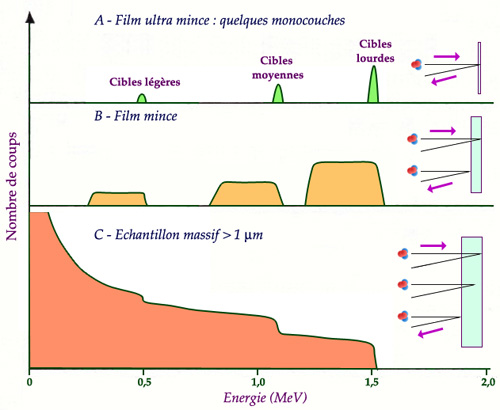
Here, a target containing 3 types of target atoms, light, medium, and heavy, is considered. In the case of an ultra-thin target composed of a few atomic layers, the spectrum is reduced to the characteristic energies of the chemical elements present. These peaks become plateaus when the target becomes thicker due to the energy loss of the incident ion during the incoming path and that of the scattered ion during the return path. The spectrum obtained with a thick target presents a particular shape consisting of successive steps with a front located at the characteristic energy of each element and a height proportional to their atomic concentration.
© C2RMF
In the RBS method, a detector collects the backscattered ions, measures their energy, and counts them. The result is an energy spectrum to be interpreted. But except in the case of ultra-thin samples, the collected energy is not the one given by the formula. When the ion is repelled by a heavy nucleus, its energy is no longer the energy provided by the accelerator. It has crossed a certain depth of material in which it has ionized atoms, which has slowed it down. After the recoil, the ion is slowed down again during the return path. The energy loss during the outward and return paths is greater the deeper the projectile has penetrated.
Light chemical elements are « transparent » with respect to Rutherford backscattering. Indeed, there is no backward recoil for a chemical element with a mass equal to or lower than that of the projectile ion. If the mass of the chemical element is not much greater (as in the case of oxygen and helium), the probability of backscattering is low and the energy lost during the recoil is high. Most of the time, the ion loses the little energy it still has during its return path and does not reach the detector.
Which projectiles should be chosen, protons or helium nuclei, for an RBS analysis? Protons are more penetrating but less selective. If the aim is to favor intermediate and heavy chemical elements, helium nuclei are generally preferred. Since their atomic mass is 4, they do not detect the most common chemical species (carbon, oxygen, nitrogen, etc.) unlike protons with an atomic mass of one.