


Analyzing the Craftsmanship of Artisans of the Past
Editorial review 2026
Many important clues about the manufacturing techniques of heritage objects can be deduced from a simple identification of the materials used to create the work. However, details concerning the way elements are distributed on the surface or in depth make it possible to go further and often provide decisive evidence.
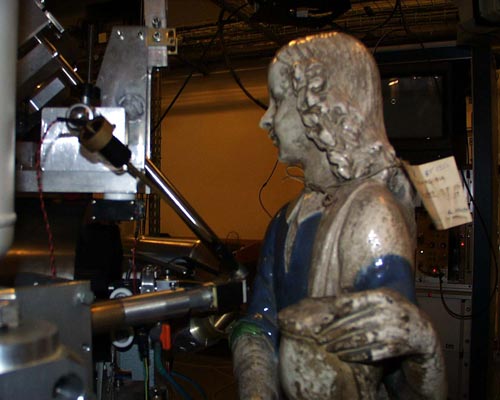
Analysis of a Renaissance Statuette
This glazed terracotta statuette comes from the workshop of the Della Robbia family, a Renaissance dynasty of artists. The statuette is shown during analysis while exposed to the particle beam extracted from the AGLAE accelerator. By identifying the materials used on the surface, the aim is to attribute the statuette to one of the members of the dynasty.
© LRMF
The PIXE method has been used, for example, to determine soldering techniques in ancient and medieval goldsmithing. A second method (elastic scattering of protons and, more recently, helium nuclei) has been applied to the study of gilded objects in order to determine the composition of the gold alloy and the thickness of the gilding.
For example, the study of the gold used in the various parts of the crowns and crosses of the Guarrazar Treasure near Toledo, Spain, provided information about goldsmithing techniques during the time of the Visigothic kings in the 8th century.
Researchers succeeded in distinguishing the original parts from the modern elements introduced during the restoration of the treasure shortly after its discovery (11th century). In their current presentation, some crosses and crowns are not correctly matched.
The gold used in these jewels was found to be of a higher purity than the coins used by the Visigothic kings of the period. They did not use the gold coins from their treasury for royal goldsmithing.