


Three muographies for a cavity…
Editorial revision 2026
A muography resembles an X-ray. In both cases, radiation is absorbed by the matter it passes through. The unabsorbed rays, collected and measured, provide an image of the object traversed, of its dense and less dense parts.
But the differences are significant. In the case of an X-ray, billions of X-rays impress a photographic film or the pixels of a detector in a fraction of a second. We control their flux. Muons are natural particles, which we do not control. Their flux is infinitely weaker. It took exposure times of several months to prove the existence of a large cavity inside the Great Pyramid of Khufu.
The proof of the existence of this previously unknown cavity is reinforced by the combination of three muography techniques. The first is that of the telescopes developed at CEA-Irfu in Saclay and placed outside the pyramid. The second and third are due to two Japanese teams: a team of researchers from Nagoya University and a second from KEK, Japan’s largest particle physics laboratory. The Japanese teams placed their detectors inside the pyramid. The Nagoya team uses the emulsion technique, while the KEK team uses scintillation telescopes (hodoscopes), electronic detectors similar to those of the French team.
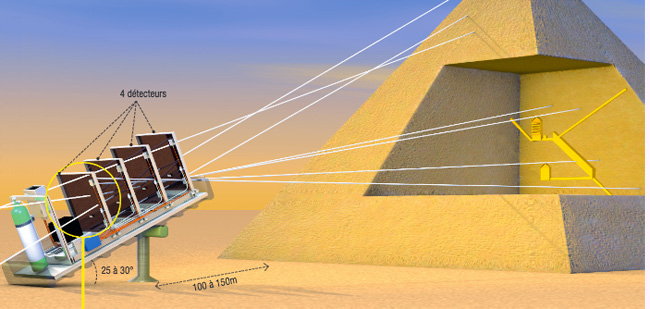
Fig.1 Principle of the Muon Telescope (micromegas)
From 5 to 10 muons from the pyramid pass through the four micromegas detectors that make up the telescope every second. The data from the 4 impacts are processed on-site by a microcomputer that reconstructs the trajectory. In the background, you can see the argon supply bottle (non-flammable, non-toxic) for the 4 micromegas. The telescope is autonomous. Powered by a battery, it consumes little electricity (30W). The microcomputer transmits the reconstructed trajectories in real-time via the internet to the CEA laboratory in Saclay.
© CEA-IRFU
Figure 1 shows the telescope for detecting muons from the CEA team. It is located outside the pyramid. The telescope consists of 4 gaseous Micromegas detectors. These planar detectors, derived from the wire chambers developed by physicist and Nobel Prize winner Georges Charpak, were invented in 1994 at CEA-Irfu and later developed in this laboratory and at CERN.
A Micromegas detector consists of a sensitive plate separating two parallel volumes filled with argon-based gas (non-toxic, non-flammable). As a muon passes through the detector, it knocks a few electrons from the gas in the first volume, called the « ionization space. » These primary electrons, accelerated by an electric field of 1 kilovolt per cm, pass through a copper micro-grid and enter the second volume, called the « amplification space. » Under the effect of an electric field 50 times more intense, the electrons undergo further acceleration, giving them enough energy to ionize the gas again. This results in an avalanche of several tens of thousands of electrons, allowing the reading electrode tracks to detect the amplified signal.
The position of the muon impact on each of the micromegas is thus recorded with a precision of 200 microns. The data from the 4 impacts are processed on-site by a microcomputer that reconstructs the trajectory, a straight line coming from the pyramid.
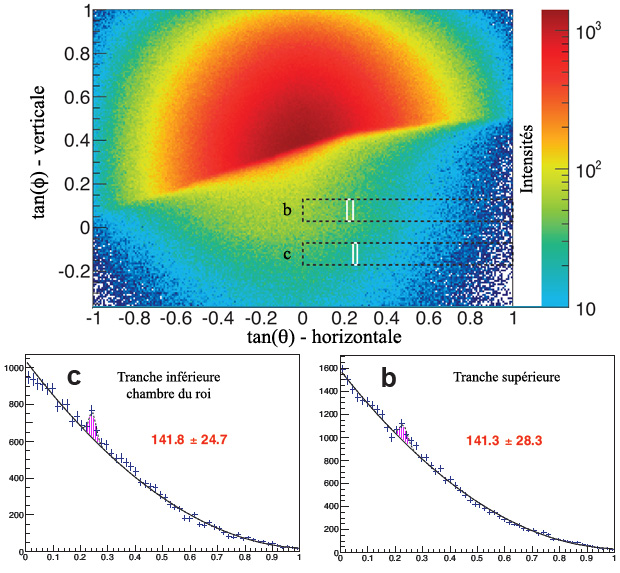
Fig.2 Muon map
After several months of data collection, here is the muon map observed by one of the telescopes. On the right, the intensity scale. The contours of the pyramid, which absorbs most of the muons, can be seen. When examining in detail the two horizontal slices indicated, a small but significant excess of muons (hatched) is observed in each of them. The excess in the lower slice comes from muons that have passed through the empty space of the King’s Chamber. The second excess in the upper slice suggests the existence of a second cavity.
© CEA-Irfu
Figure 2 shows the map obtained by one of the Saclay telescopes, called Alhazen (the map from the second detector, Brahic, is similar). The edges of the pyramid can be distinguished. Like images from digital cameras, the map can be analyzed in detail. Inside the pyramid area, the analysis of two slices located at different heights shows an excess of muons at a given position (hatched). The first excess corresponds to the void resulting from the presence of the King’s Chamber at the heart of the pyramid. The direction of the second excess suggests the existence of a cavity of similar size, but previously unknown.
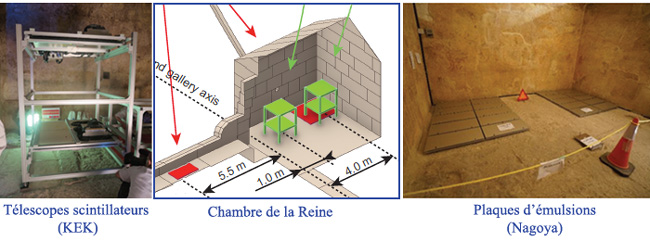
Fig.3 Japanese detectors inside the pyramid
Locations in the Queen’s Chamber of the photographic emulsion plates from Nagoya University (right) and the scintillator telescopes from KEK (left).
© ScanPyramids
The hypothesis of a new cavity is confirmed by the results of the two Japanese teams. Installed at the heart of the pyramid, in the Queen’s Chamber, the Japanese detectors detect muons with different inclinations, from top to bottom (Fig. 3). Set up from December 2015 on the floor of the Queen’s Chamber, the emulsions from Nagoya University were the first to suggest the existence of a void.
An emulsion is similar to the silver film of our cameras before the digital era. Muons leave a straight trace in the emulsion, which faithfully records their passage during the long exposure. When the plate is developed at the end of the data collection, the multiple traces generated during this time are found. The emulsion technique had its heyday in the heroic early days of particle physics when only cosmic radiation was available, and plates were carried in balloons. The emulsions were then analyzed under a microscope! But times have changed. After their development on-site, the films were transported to Nagoya University to be analyzed by a scanner.
The telescope of hodoscopes designed at KEK uses a proven technique. It consists of two units, each containing two layers of scintillator bars arranged orthogonally. The planes of the two units are 1.5 meters apart. Each layer is composed of 120 plastic scintillator bars with a cross-sectional area of 1 cm², covering an area of 120 × 120 cm². The passage of a muon through a scintillator bar triggers a flash of light that is collected. The simultaneous detection of scintillations in 4 bars located in 4 distinct layers indicates the passage of a muon. The collected information allows for trajectory reconstruction. The precision in angle is lower than that of the micromegas, but since the telescope is installed at the center of the pyramid, it is closer to the cavity.
The signals observed by the two Japanese experiments are of the same order as those of the French experiment: small but significant. They confirm the existence of a cavity. The viewing angles (internal and external) allow its location to be pinpointed above the Grand Gallery. Its volume would be comparable to that of the King’s Chamber. It is not yet possible to say whether it is horizontal or inclined.
We are far from the precision of an X-ray. The smallness of the signals is due to the fact that even a large cavity occupies a minimal volume within the enormous rocky mass of the pyramid. Muons that pass through the cavity do so drop by drop. It takes the expertise of physicists to read the map and interpret the data.
Research is underway to improve the performance of micromegas detectors. First, to reduce argon consumption and make them sealed so they can be installed inside the pyramids. Then, the goal is to increase their acceptance, obtain sharper images, and achieve more precise directional measurements. Finally, reducing the size and weight of the telescopes would make them more portable. Beyond the mysteries of the pyramid of the great pharaoh, engineers and physicists hope for many other applications!
Video (10 min) made from interviews with researchers from the ScanPyramids team at Irfu: Estelle Lemaitre, October 30, 2017