


Gamma rays against insects and for disinfection
Editorial review 2026

Treatment of cultural heritage by gamma irradiation
These three apostles and the two angels accompanying them are certainly surprised to see their statuettes irradiated by an intense flux of gamma rays. But this irradiation, carried out for their benefit, aims to eliminate wood-boring insects that feed on the wood from which they are made …. Polychrome wooden statuettes of apostles and angels, 17th century, commune of Le Pègue (Drôme).
© C. Albino/Arc-NUCLEART
Irradiation by ionizing radiation constitutes today the disinfection technique for materials that receives the greatest confidence from professionals in sanitary services, whether in the fields of medical, pharmaceutical, parapharmaceutical (cosmetics) sterilization, food preservation or import/export control services. From destructive insects to pathogenic bacteria, including saprophytic fungi and molds, the method has widely demonstrated its effectiveness and reliability (NB: a saprophyte is a plant, fungal or bacterial organism capable of feeding on non-living organic matter. It can cause the decomposition of this matter by releasing digestive enzymes). This is especially true in the case of gamma rays, the most penetrating among ionizing radiations, for which it is easy to ensure that the physical conditions leading to the death of the targeted species are reached, even through wrapped and packaged objects.
Disinfestation and disinfection by irradiation have also been successfully used for forty years by the Arc-Nucleart workshop in the field of cultural heritage. From private furniture to prestigious collections in national museums, several thousand cubic meters of objects have undergone these treatments. Among the advantages of this method is, of course, the ability to treat large quantities at once, without contact, without the use of any chemical or other products, and therefore without any residual effect. The possibility of treating through the packaging and/or conditioning itself avoids repeated direct handling and the associated risks of damage.
Compared with competing techniques (chemical treatments by fumigation, injection or surface application, physical treatments by anoxia, microwaves, cold, UV …), the feedback is very positive, both in terms of effectiveness and reliability, as well as regarding the harmlessness for objects and the safety of people who must handle these objects after treatment or during their presentation to the public.
The radiation dose required for treatment varies according to the targeted species. It is a minimum of 500 Gy (Grays) for insect treatments and must be adapted; it can reach up to 10000 Gy (10 kGy) for fungal treatments. Depending on the geometry and density of the objects, an overdosing factor between the most and least exposed parts of the object must also be taken into account (a typical factor of 1.5 to 2). These quantities should be compared with 4 Gy, the lethal dose for humans.
The choice of one disinfestation or disinfection method over another must be considered globally according to the advantages, disadvantages and compatibility of each technique. In practice, reliability and effectiveness justify gamma treatments, particularly when treating large quantities or volumetric and/or packaged objects.
This irradiation treatment is therefore particularly suitable for the disinfestation of furniture, statues, ethnographic objects, naturalized specimens, mummies and other cultural heritage objects made of organic materials. It is, however, not justified a priori for the disinfestation of objects without volume if they can be treated individually.
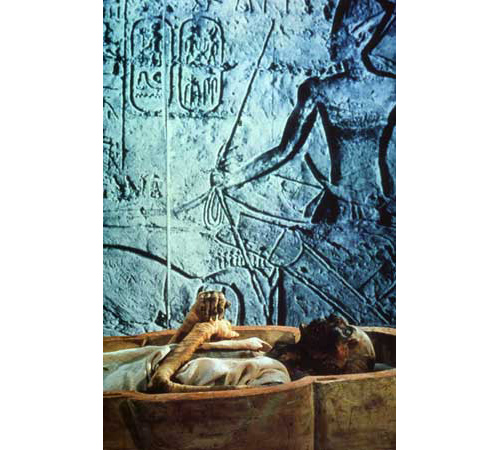
Mummy of Ramses II
In 1977, the Cairo Museum discovered that the mummy of the pharaoh Ramses II was infested with larvae and fungi. It requested assistance from France and the CEA to treat the mummy by irradiation. This was preceded by numerous tests, particularly on other mummies, to verify its safety. It should be noted that the Republican Guard was present when the pharaoh’s mummy arrived (as required for a head of state). The mummy, sarcophagus and base had to be transported back and forth from the Cairo Museum to Saclay (it had been decided not to go as far as Grenoble), inside a sterile enclosure.
Since then, sterility has been ensured by a plexiglass chamber equipped with submicron filters to allow ventilation without risking reinfestation by fungal spores that could settle on the mummy. © Arc Nucléart
Regarding fungal species (fungi), there are currently few or no alternative techniques offering similar guarantees in terms of harmlessness, effectiveness and treatment reliability. Gamma disinfection may be carried out when conservation requirements justify it. This is, for example, the case when it is not possible to control the proliferation of these species and the associated devastating effects due to environmental conditions, or when the level reached poses major risks to the collection and/or to the people responsible for it.
It must be remembered that the action of this type of treatment is only curative, which requires that strong preventive measures be taken in parallel. This is why, for the vast majority of cultural heritage objects, these disinfection treatments (fungicidal treatments) remain limited, because climate control is generally sufficient to manage ongoing contamination (as long as it remains at a controlled level), and is in any case necessary even after curative treatment to prevent inevitable recolonization due to the normal load of spores present in the atmosphere.
… Depending on the dose, these treatments may induce effects on certain classes of « sensitive » materials (for these materials, attention must also be paid to the cumulative dose that repeated disinfestation or disinfection operations could generate).
Material compatibility
The concept of material compatibility is closely linked to the dose.
The first class of so-called sensitive materials consists of transparent materials or those presenting a certain translucency. These materials do not generally require disinfestation or disinfection themselves, but they may be associated with organic materials that do. Indeed, most of these materials (glass, crystals, transparent or translucent gemstones, transparent plastics …) tend to become opaque or change color under the action of gamma radiation, starting from disinfestation doses in the order of kGy (these optical appearance variations are nevertheless often reversible, at least partially). Except for specific materials, the rule is therefore to avoid irradiating them. Other less translucent materials such as marble, white mother-of-pearl, ivory, bone, horn and shells may also show perceptible yellowing at disinfection doses of around several tens of kGy, but this effect is almost invisible at disinfestation doses.
The second class concerns mechanically sensitive materials. For example, for paper, a decrease in the degree of cellulose polymerization has been observed at disinfection doses. Similarly, an initial alteration of leather structure has been observed at slightly higher doses. It should nevertheless be noted that none of these structural modifications has been observed at disinfestation doses, and that at disinfection doses they do not in any way result in deterioration of their macroscopic properties. Given the lack of alternatives, the treatment of graphic documents and archives is today practiced even at disinfection doses, depending on conservation requirements.
Although few dedicated studies have so far concerned textiles, their behavior can be compared with that of leather for protein-based materials (animal origin, silk, wool…) and with that of paper for cellulose-based materials (plant origin, cotton, linen…). Skins, hair and feathers can also be added to this list. Gamma disinfestation treatment of all these materials is common practice at ARC-Nucléart and has never caused problems. A possible disinfection treatment up to 10 kGy may also be considered, depending on conservation requirements, but must be properly justified.
Finally, in France, it is not customary to treat easel painting using these gamma radiation methods. However, we specify that numerous studies in this field have always demonstrated that gamma radiation does not cause any alteration to polychrome surfaces, even at disinfection doses. The treatment of polychrome statues, on the other hand, is widely accepted and is practiced very commonly in France and in various countries.
Laurent Cortella, Head of irradiation facilities and operations at ARC-Nucléart