


Detailed Analysis of Chemical Elements Present on the Surface
Editorial review 2026
The identification of the raw materials used, the way they were mixed, and the treatments applied are part of understanding a work of art. When doubts remain regarding its origin, these data provide strong evidence for the authentication of a work and its attribution to an artist or workshop.
In archaeology, the identification of raw materials contributes to a better understanding of technological development in the distant past and offers the possibility of indirect dating through similarities in composition with well-dated objects.
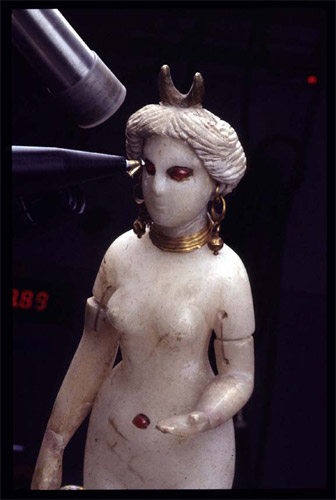
Analysis of the Rubies of the Goddess Ishtar
This Parthian statuette represents Ishtar, the Parthian goddess of love. The particle beam extracted from the AGLAE accelerator is focused on one of the red gemstones embedded in the eyes and navel of the statue. The objective is to identify the nature and origin of these colored stones. Analysis using the PIXE method showed that they are rubies extracted in antiquity from a mine located in Burma.
© LRMF
The method most commonly used at the Research Laboratory of the Museums of France (LRMF) at the Louvre is the PIXE method. Extremely sensitive and precise, it makes it possible to analyze the composition of details such as an inlay, the letters of a parchment manuscript, or the lines of a drawing.
For example, it was long believed that the red inlays of a Parthian statuette representing the goddess Ishtar in the Louvre Museum were made of colored glass. These red inlays are located in the eyes and navel of the statuette. Mineral identification showed that they were actually rubies. Indeed, the PIXE spectrum of the major elements indicates the presence of aluminum and chromium, characteristic of natural rubies.
The technique has also revealed the use of several types of metal styluses in the drawings of Pisanello: lead or a silver-mercury alloy on parchment or untreated paper; pure silver on paper treated with a preparation based on bone white or calcium carbonate.
A recent study was devoted to the identification of pigments used in the illuminations of medieval manuscripts preserved at the National Library of France.