


The Radium Institute
Editorial review 2026
The Curie Museum is located in one of the former buildings of the Radium Institute. Several areas have been preserved in their original state: Marie Curie’s office and chemistry laboratory in the Curie Pavilion, as well as the garden of the Radium Institute. These historic places can now be visited and retain the atmosphere of an interwar research laboratory.
The site can be visited free of charge. It is open from Wednesday to Saturday, from 1 p.m. to 5 p.m. Last admission is 10 minutes before closing time. Due to high attendance on certain days, entry may be restricted after 4:30 p.m.
Since 2018, more than 9,000 measurements have been carried out in the museum. Some objects and books are still slightly contaminated with radium. This is also the case for some pieces of furniture and the parquet flooring. Obviously, these are extremely small quantities, since cleaning operations have been carried out since the site was transformed into a museum.
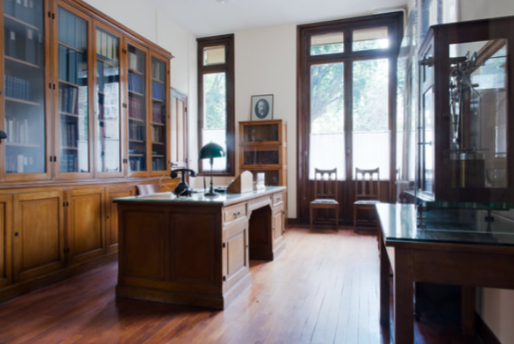
This is Madame Curie’s original office. The office is located at the heart of the area reserved for the director. From here, Marie Curie could access the physics room (door on the right), the chemistry room, her resting room (door on the left), her private restroom and her private entrance. © Curie Museum
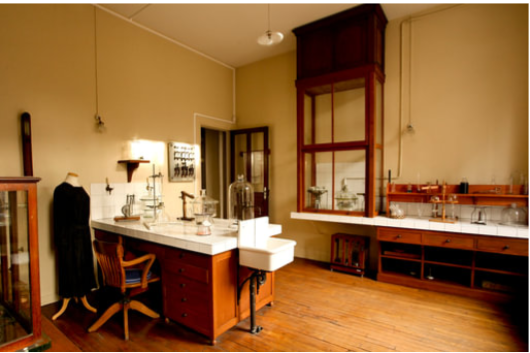
The chemistry laboratory housed Marie Curie’s research on radioactivity for nearly 20 years, from 1915 to 1934. It was subsequently occupied by the directors and directresses who succeeded her, until 1958. After decades of use, the site, contaminated by radioactivity, underwent significant decontamination in 1981. Today, the chemistry laboratory is the result of a reconstruction based on period equipment and recreated furniture. It can now be visited safely by thousands of visitors.
© Curie Museum
As an example of slightly contaminated objects, positive measurements were obtained on small laboratory items. They are preserved under the laboratory fume hood. They are part of the historical heritage and show that they were used to handle radioactive materials.
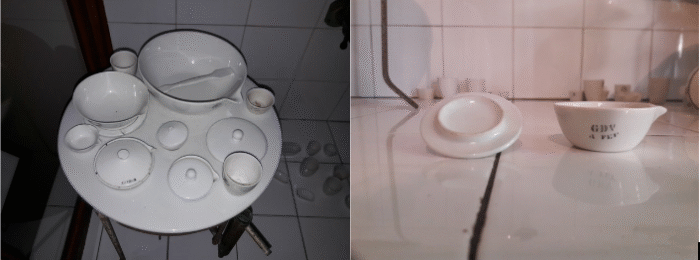
Lidded container: Alpha measurement: 22 cps – Beta measurement: 27 cps. © Marc Ammerich
Another heritage object: the chairs located in the office:
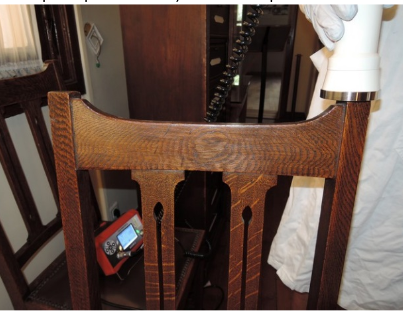
Another heritage object: the chairs located in Marie Curie’s office. Alpha measurement: 2.5 cps – Beta measurement: 2.9 cps. © Marc Ammerich.
Another heritage object: Pierre Curie’s thesis:
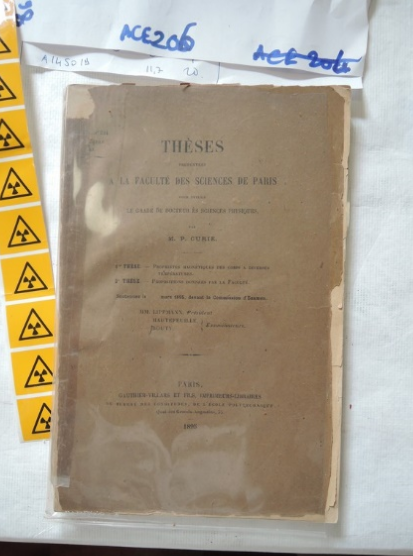
Measurement on the book: Pierre Curie’s thesis (under the plastic cover). Alpha measurement: 15 cps. Beta measurement: 600 cps. Probably a radium-226 stain.
GM measurement: beta measurement: 670 cps. Dose equivalent rate measurement: 8.7 µSv/h on contact. © Marc Ammerich.
Other articles on the subject « Cultural heritage objects »
The Natural History Museum
The Natural History Museum 2026 editorial revision In the Jardin des Plantes in Paris, there is a[...]
The National Library of France
The National Library of France holds part of the Curie archives Editorial review 2026 It holds, f[...]
The other museums
Editorial review 2026 Many other museums hold radioactive objects that are sometimes displayed (b[...]