


Impurities as Signatures of the Origin of Precious Stones
Editorial review 2026
Determining the origin of materials provides a key to understanding trade routes and relationships between ancient populations. A typical example is provided by the determination of the origin of the rubies found in a Parthian statuette discovered in Mesopotamia, whose authenticity had already been demonstrated by analyses carried out at the Louvre.
The Parthian Empire lasted for approximately five centuries, from 250 BC to AD 250. It was located on the borders of the Roman Empire, in the area corresponding to present-day Iran. To determine the origin of the rubies of the goddess Ishtar, the Louvre laboratory measured the composition of approximately 500 rubies from different mines using the PIXE method. Each ruby was characterized by different traces of natural elements.
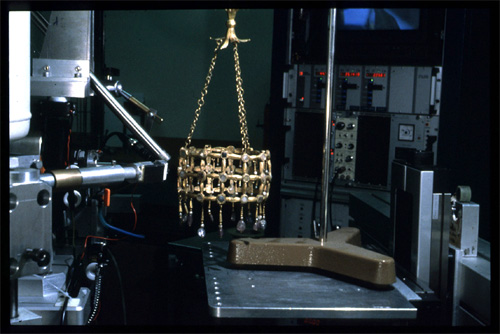
Visigothic Tiara of Guarrazar
This crown from the Guarrazar Treasure (Spain) is shown in analysis position, facing the beam extracted from AGLAE. This treasure was hastily buried during the Arab invasion by one of the last Visigothic kings. The aim is to analyze the origin of the emeralds mounted on this tiara.
© LRMF
The composition of the rubies in the statuette was compared with rubies from all the mines from which the gemstone could have been extracted. The traces of natural elements found in the statuette’s rubies indicate that they originated in Burma and constitute valuable evidence of a gemstone trade route between Mesopotamia and the Far East.
More recently, this method has been applied to the study of the origin of the emeralds mounted on Visigothic votive crowns. The Visigoths ruled Spain from the fall of the Roman Empire until the Arab conquest. These crowns belong to the royal treasure of Guarrazar (8th century), near Toledo, part of which is preserved at the National Museum of the Middle Ages in Paris.
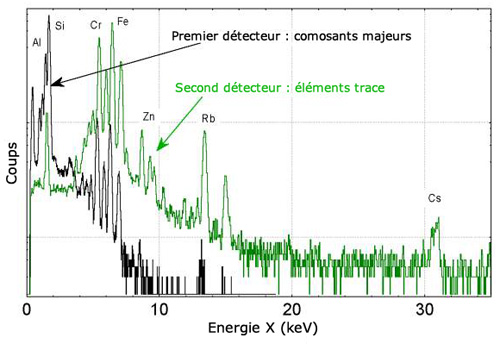
PIXE Analysis of an Emerald from the Tiara
This « energy spectrum » shows the distribution of the energy of the X-rays detected during the irradiation of an emerald by the particle beam from the AGLAE accelerator. The characteristic lines of zinc, rubidium and cesium impurities can be observed. These impurities, true “genetic fingerprints,” make it possible to establish that the emeralds belonging to a Visigothic crown from the Guarrazar Treasure (Spain) originated from a mine in Tyrol.
© LRMF
The impurities detected in trace amounts by the PIXE and PIGE methods can be compared to genetic fingerprints. They led to the conclusion that these emeralds were very probably extracted from the Habachtal mines in Tyrol. This result is particularly interesting because the exploitation of these mines is only documented much later, around the 15th century.