


Treatments using the Arc Nucleart irradiator in Grenoble
Treatments using the Arc Nucleart irradiator in Grenoble
Upon arrival at ARC-Nucléart, the objects are stored in their packaging in a climate-controlled quarantine storage area near the irradiator. For obvious capacity reasons, it is recommended not to exceed 20 m3 to 30 m3 of objects per delivery.
The Arc Nucleart irradiator in Grenoble is a pool-type irradiator, meaning that when not in use, the radioactive sources are stored in a pool. This pool is connected to the irradiation cell, a type of shielded chamber with walls 1.5 m thick, by means of a channel running underneath its wall. When there is no source inside, access to the cell is possible through a motorised door mounted on rails, which is also 1.5 m thick. Once the personnel have left and the door has been closed, the sources, arranged on a mobile source rack, can be moved along a rail through the channel and raised into the cell to irradiate the materials placed there.
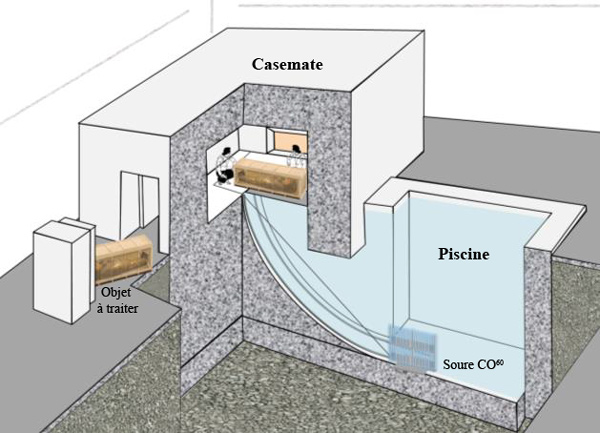
Preparation for irradiation
First, the object or objects to be treated are placed in the shielded chamber, while the radioactive cobalt-60 source, consisting of rods, remains at the bottom of the adjacent pool, which provides protection from radiation.
© ARC-Nucleart
The radioactive sources used to produce gamma rays are sealed Cobalt-60 sources, in sufficient quantity to routinely carry out disinfestation treatments at 500 Gy (grays) within a day, depending on the size of the objects. The objects, still in their packaging, are generally turned over halfway through the irradiation process to ensure a uniform dose. After treatment, the sources return to the storage pool, and personnel can immediately retrieve the objects. The objects are then transferred to the workshop’s clean storage areas, located in another building, where they remain until they are returned to the client.
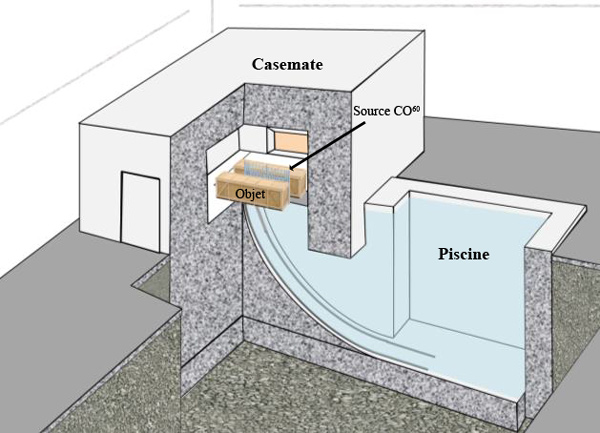
Irradiation phase
For treatment, the trolley carrying the radioactive source is raised from the pool with the door of the shielded chamber closed. At the back, a lead-glass viewing window, which absorbs radiation, makes it possible to monitor and control the operations.
© ARC-Nucleart
The volume inside the cell is 4 m by 4 m, with a height of 2 m. In the irradiation position, the source rack therefore divides the space into two areas measuring 2 m by 4 m on either side. However, it is primarily the dimensions of the doorway (1 m wide, 1.90 m high and 1.50 m deep) that determine the maximum size of the objects that can be treated (the clearance distance of the door, limited to 3 m, must also be taken into account, as this can become a limiting factor for long and wide objects).
Following these treatments, there is no “post-irradiation effect” in the sense of induced radioactivity:
– no contamination, because the Cobalt-60 sources are contained and there are no traces of contamination in the facility,
– no activation, because material exposed to gamma radiation from Cobalt-60 does not become radioactive under any circumstances, even during the irradiation itself, since there is no modification of the atomic nucleus (no nuclear reaction) in the irradiated material, but only interaction with the electron cloud (ionisation) of the irradiated atoms.
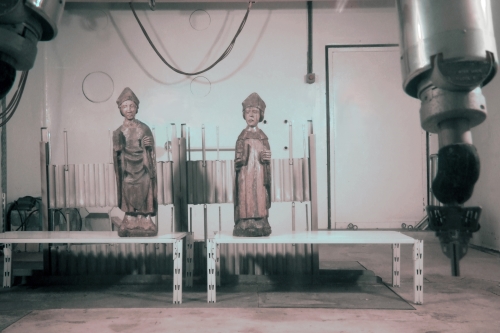
Treatment of two statues
Two statues were placed in the irradiation chamber. The rods of the radioactive cobalt-60 source can be seen behind them, with the entrance door on the right.
© Arc-Nucleart
The irradiated objects can therefore be handled immediately after irradiation without any special precautions.
Laurent Cortella, Head of Irradiation Facilities and Operations at ARC-Nucléart