


Actors and foundations of radiation protection regulations
Editorial review 2026
Radiation protection rules are not specific to France, but result from guidelines provided at the global level. Standards, norms or recommendations are established internationally by various organizations. Several actors contribute to the development of radiation protection rules and their legal framework.
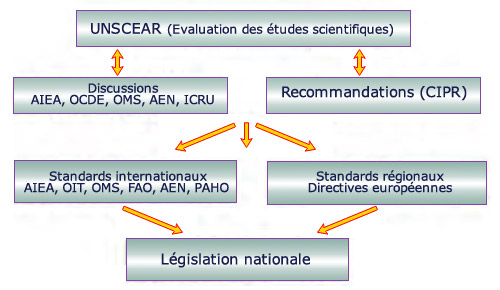
Development of radiation protection rules
The directives and Basic Safety Standards of radiation protection are based on analyses by UNSCEAR and recommendations of the ICRP. They are discussed at the international level by major institutions such as the International Atomic Energy Agency (IAEA), the Food and Agriculture Organization of the United Nations (FAO), the International Labour Organization (ILO), and the World Health Organization (WHO), and at the European level by EURATOM before leading to national legislation.
© Source ASN
– The “United Nations Scientific Committee on the Effects of Atomic Radiation”, UNSCEAR (United Nations Scientific Committee on the Effects of Atomic Radiation), is composed of high-level experts representing the countries concerned. This committee regularly publishes reports on exposure to natural and artificial radiation that take into account the evolution of knowledge and professional experience.
– The International Commission on Radiological Protection (ICRP) goes further by publishing recommendations on the protection of workers, the public and patients against ionizing radiation. A non-governmental organization, the ICRP is also composed of experts co-opted from various disciplines from around the world. Its recommendations are based on UNSCEAR reports and take into account the state of knowledge. The ICRP published in 2007 new guidelines updating the previous ones, ICRP60, published in 1991.
– The International Atomic Energy Agency (IAEA) regularly publishes and revises standards in the fields of nuclear safety and radiation protection based on ICRP recommendations. It collaborates in the publication of international standards for protection against ionizing radiation and for the safety of radioactive sources with the World Health Organization (WHO) and other major organizations. The IAEA has also initiated a revision of the International Basic Safety Standards for radiation protection, while a new standard on fundamental safety principles was published at the end of 2006;
-At the European level, the Euratom Treaty specifies how radiation protection standards are established and defines the powers and obligations of the European Commission regarding the way they are implemented in the different countries. Euratom Directive 2013/59 establishes the basic standards for the health protection of the public and workers against the dangers arising from ionising radiation, and for protection against the dangers of radiation during exposures for medical purposes. Euratom Directive 2003/122, which applies to the control of high-activity sources and orphan sources, specifies elements that are not included in the latter directive.
See also:
ASN website (Nuclear Safety Authority)
IRSN website
– UNSCEAR 2000: SOURCES OF IONIZING RADIATION : Natural sources
– UNSCEAR 2000: SOURCES OF IONIZING RADIATION : Sources due to human activities