


A useful indicator, but to be used with caution
The sum of the individual doses received by a population is called the collective dose. This collective dose is expressed in man-sieverts (man·Sv). It is calculated by multiplying the average effective dose (expressed in sieverts)
by the number of people concerned.
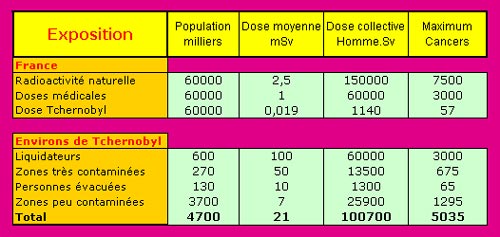
Calculation of collective doses
The table shows, through several examples, how multiplying the number of people by the average effective dose gives the collective dose.
Going further, by multiplying the collective dose by 5%, one can estimate the expected number of cancers.
This calculation is valid for effective doses exceeding 100 mSv.
Below this threshold of low doses, the number of cancers should be regarded as a maximum estimate.
© IN2P3 (Source: IRSN).
Values of collective doses for populations of several million people exceed the thousand mark even for low exposures.
For example, in France, with a population of 60 million inhabitants, the annual collective doses due to natural radioactivity and medical exposure are 150,000 and 60,000 man·Sv respectively, while the average individual exposures are around 2.5 and 1mSv (millisievert).
By comparison, the collective dose of the 4,700,000 people living in the Chernobyl region is 100,700 man·Sv.
This exposure is very unevenly distributed between the general population and those who participated directly or indirectly—the “liquidators”—in the decontamination operations.
The value of the collective dose lies in providing an estimate of the risk to an exposed population.
However, this indicator should be used with caution.
There is a strong temptation to convert these collective doses into a predicted number of future cancers by applying the
ICRP rule, which assumes up to 5% of fatal cancers per sievert (the “linear no-threshold” relationship).
Since 1990, experts from the UNSCEAR have opposed the use of the product of environmental collective doses and the 5% coefficient to estimate the number of cancers attributable to human population exposure.
For example, the collective dose of 60 million French people who each received an average of 1 mSv from X-rays or CT scans is equivalent to that of the 600,000 Chernobyl liquidators exposed to 100 times higher doses.
According to the proportionality rule of the ICRP, the number of expected cancer cases would be the same.
However, since radiation effects are not observed at doses as low as 1 mSv, the actual number of cancers will be significantly higher among the Chernobyl liquidators.
Although it is not very meaningful for comparing very different types of irradiation,
the concept of collective dose is useful for reducing exposures to the lowest possible level in professional or industrial environments.
Continuous optimization of procedures in industry and maintaining a high level of radioactivity control in facilities
have helped to lower collective doses and improve worker protection,
particularly in the nuclear industry and in medicine.