


Nucleus and Electrons
Editorial review 2026
An atom consists of a nucleus surrounded by a cloud of electrons. The nucleus itself is made up of two types of nucleons: neutrons, which are electrically neutral, and protons, each carrying a positive electric charge +e (where e is the smallest electric charge that can exist in isolation, known as the “elementary charge”).
An electron is an elementary particle carrying the negative electric charge -e. Thus, an electrically neutral atom contains as many electrons as protons. The number of protons, denoted Z, determines the atomic number, which defines the chemical element to which the atom belongs. The chemical properties of an atom depend on the way its electron cloud interacts with those of other atoms.
The mass of an electron is about 2,000 times smaller than that of a nucleon. The mass of the atom is therefore almost equal to that of the nucleus, the contribution of the electrons being very small. The term “mass number,” denoted A, refers to the number of nucleons contained in the nucleus. The mass of an atom is proportional to its mass number. For a given atomic number Z, different mass numbers A are possible (by varying the number of neutrons): the corresponding atoms are called isotopes.
For example, an atom whose nucleus contains 6 protons is a carbon atom, and if it is a neutral atom (rather than an ion), its electron cloud contains 6 electrons. Most existing carbon atoms also contain 6 neutrons: they are called carbon-12 and have a mass number A = 12. If the carbon nucleus contains 8 neutrons, it is a different isotope: carbon-14 (radioactive and used for dating). The simplest atom consists of one proton and one electron: the hydrogen atom. At the other end of the scale, among the heaviest elements found naturally on Earth is uranium, with 92 protons. In laboratories, nuclei containing more than 100 protons have been produced.
A Mass Concentrated in the Nucleus and a Great Deal of Empty Space…
The familiar image of the atom, with electrons orbiting the nucleus like planets around the Sun, is appealing but misleading, because the atom is in fact much more complex. Its constituents—nuclei and electrons—obey the laws of quantum mechanics. Thus, the first modern model of the atom, proposed by the Danish physicist Niels Bohr in 1913, introduced quantum laws into the description of the atom by describing the specific orbits occupied by electrons. The nucleus itself possesses a structure governed by quantum rules.
Nevertheless, the simplified image of the nucleus as the center of a miniature planetary system correctly reflects the idea that almost all of the atom’s mass is concentrated within a very small region at its center. Indeed, the nucleus contains virtually all the mass of the atom, while its size is 100,000 times smaller than that of the atom itself. Its density therefore reaches astonishing values: approximately 230,000 tonnes per cubic millimeter.
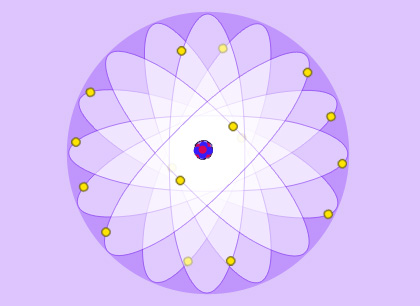
An Atom Made Mostly of Empty Space
The simplified representation of the atom as a miniature solar system illustrates the fact that nearly all matter is concentrated in a tiny nucleus. The rest consists of empty space through which electrons, two thousand times lighter than nucleons, move. The nucleus is approximately one hundred thousand times smaller than the atom itself.
© IN2P3
Other articles on the subject « The atomic world »
The electron
The best known of elementary particles The electron is an elementary particle that plays a fundam[...]
Atomic Energy Levels
A shell structure …. The conquest of space has familiarized us to the concept of a satellit[...]
Photons
The elementary components of light and electromagnetic waves Light is composed of infinitesimal i[...]
Orders of Magnitude
The very small and the very large … The atom, and the nucleus in particular, belong to the [...]
Avogadro’s Number
Trillions of billions of very small atoms …. The microscopic size of atoms comes with their[...]
E=MC²
The Einstein formula, a relation between mass and energy The energy released by a chemical reacti[...]