


ADS: Accelerator-Driven Systems
It is not written in the laws of Nature that the only possible form of nuclear energy is the one we know today. Among the reactor technologies that may emerge in the future, one of the most attractive because of its innovative nature is that of hybrid reactors, or ADS (Accelerator Driven Systems). ADS would combine two proven technologies—particle accelerators and nuclear reactors—with the accelerator supplying an external source of neutrons.
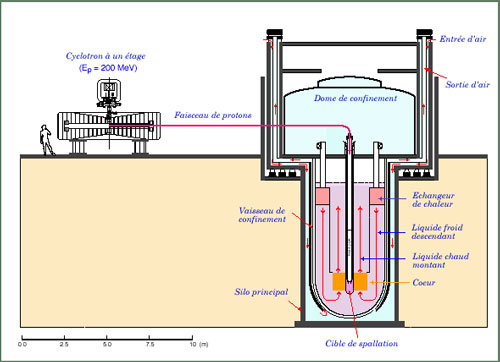
Hybrid reactor diagram
On the left side of this diagram, a particle accelerator (cyclotron) delivers a beam of 200 MeV protons. These protons travel through a vacuum tube and enter the reactor core vertically, where they strike a target. The collisions with the target generate so-called « spallation » neutrons, which multiply by inducing fission reactions. The reactor core consists of thorium (or uranium), to which fissile nuclei and radioactive waste to be transmuted have been added. The heat dissipated in the core is removed by one of the heat exchangers using molten lead before being converted into electricity.
© DRA (Source: S. Adriamonje).
Current reactor technologies are a legacy of the military developments of the 1950s. These reactors, which still operate essentially on the same principles as they did more than 50 years ago, were originally designed for the production of plutonium and for powering submarines and aircraft carriers. This is why pressurized water reactors (PWRs) inherited a fuel cycle based on uranium, a reprocessing process, and even radioactive waste resulting from the strategic choices of that period, all centered around plutonium.
Conventional reactors are not the only way to use nuclear fission to produce electricity. Their thermal efficiency is limited because the temperature inside the core does not exceed 400°C. Furthermore, due to the irradiation resistance of the fuel cladding, it is difficult to increase the fuel burn-up of fissile materials and therefore to keep them in reactors for more than four years in order to burn them more completely.
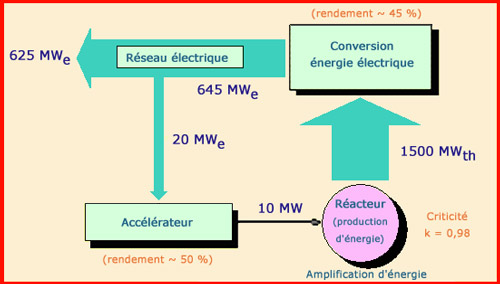
An Energy Amplifier
In a hybrid reactor, the energy required to operate the accelerator is small compared with the thermal and electrical power generated by the reactor. For this reason, hybrid reactors are sometimes referred to as « energy amplifiers. » The figure shows the energy balance of a 1,500 MW (thermal) energy amplifier proposed by Carlo Rubbia. The electrical power consumed by the accelerator would amount to 20 MW. After converting heat into electricity, the electrical output would reach 625 MW—more than thirty times the power consumed by the accelerator.
© IN2P3 (Source: J. P. Revol).
The idea of coupling a high-intensity particle accelerator with a nuclear reactor dates back to the 1950s at Los Alamos. Thanks to the additional neutrons supplied by the accelerator, the reactor can operate in a subcritical state while still producing energy. The chain reaction loses its explosive character. Simply shutting down the accelerator is enough to stop the reactor.
A Nuclear Waste Burner
The idea of coupling a high-intensity particle accelerator with a nuclear reactor dates back to the 1950s at Los Alamos. Thanks to the additional neutrons supplied by the accelerator, the reactor can operate in a subcritical state while still producing energy. The chain reaction loses its explosive character. Simply shutting down the accelerator is enough to stop the reactor.
The accelerator would deliver protons with enough energy to eject around twenty neutrons from a heavy nucleus during a collision. These neutrons, known as spallation neutrons, would then interact with the reactor’s fissile material, triggering a limited number of fission reactions because the reactor remains subcritical. Even so, the number of fissions would be high enough that the energy recovered would far exceed the energy consumed by the accelerator.
The surplus of fast neutrons would provide great flexibility in the choice of fuel. It would be possible to use thorium-based fuels (which are more abundant than uranium), destroy existing plutonium without producing more, and burn actinides, which are considered the most problematic radioactive waste produced by nuclear energy. ADS systems are primarily being developed for this application of radioactive waste transmutation.
These advantages make hybrid reactors highly attractive, but this technology still requires significant technological developments. Ambitious research programs have been launched to validate its fundamental principles. A first demonstration facility, preceding an industrial-scale prototype, began to take shape in 2015. This is the MYRRHA project, supported by the European Community and developed at the MOL research center in Belgium.
The road ahead is still long—very long. The MYRRHA accelerator will be nearly 300 meters long. By 2026, the plan is to build a 100 MeV (mega-electron-volt) particle accelerator to demonstrate the reliability of the future 600 MeV accelerator that will be constructed during the second phase.
PAGES ANNEXES: For more information about this technology
– 1): Principle of ADS Reactors
– 2): Subcritical Reactors
– 3): ADS Fuels