


What can we learn from the atomic nucleus?
Since the beginning of the 20th century and E. Rutherford’s discovery of the atomic nucleus, physicists have been trying to understand the structure of the atomic nucleus. The stability or instability of nuclei depends on the distribution of protons and neutrons. Since the 1940s, it has been known that some nuclei have greater energetic stability for specific values (2, 8, 20, 28, 50, 82 and 126) of protons and/or neutrons: these are known as “magic” numbers. To explain this, theoretical models have been developed that take into account the interactions between nucleons. Some of these models assume that nucleons are distributed among well-defined energy levels (the shell model), in a way similar to electrons in atoms. “Magic” nuclei are analogous to noble gases in atoms.
Since the 1930s, constant technological and instrumental progress has made it possible to discover more than 2000 artificial nuclei and study their properties (mass, half-life, energy states, etc.). However, there are still at least as many nuclei yet to be discovered in order to understand where the limits of their stability are located.
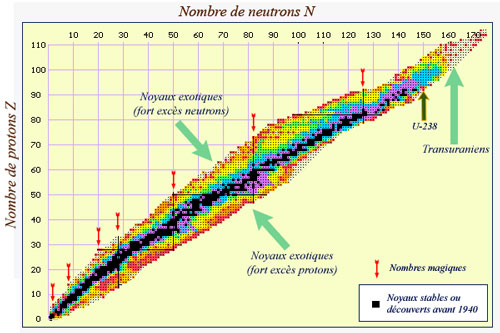
Map of nuclei
The nuclides known today, coloured according to their year of discovery. Unstable nuclei are located on both sides of the stability line and along its extension. In this extension (to the right of the map), we find the “transuranium” nuclei, which are heavier than uranium (92 protons).
© NUCLEUS
An example: identifying rare nuclei
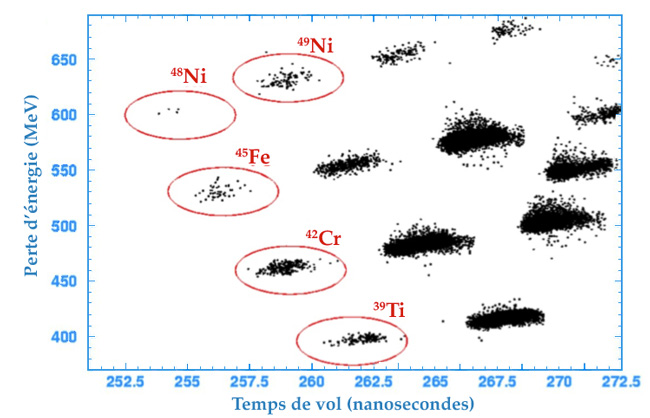
GANIL allows target atoms to be bombarded with accelerated ions. During the resulting violent collision, all kinds of nuclei are produced. Detectors located downstream of the collision are used to identify the nuclei produced. In the example below, both the energy loss of the nucleus in the detector and its travel time are measured. This makes it possible to identify a few nuclei of a very rare isotope of nickel, nickel-48.
Cutting-edge research
Each point on this graph corresponds to a single detected ion. Different types of atomic isotopes can be identified. Nickel-48 (⁴⁸Ni) is one of the rarest atoms in the Universe.
© GANIL
Example of research on super-heavy nuclei
The accelerator makes it possible, by bombarding heavy nuclei with other nuclei, to form nuclei located far beyond thorium on the nuclear chart. These super-heavy nuclei, which have a real existence, are one of the research topics at GANIL.
Video: DROUPIXIUM. A researcher who discovers a new atom can give it their name! When Droupix learns this, he seizes the opportunity to enter the History of Science and dives into the world of physics. From his secret laboratory (here, SPIRAL2 at GANIL), he finds himself 9 metres underground, right in the middle of Caen and nuclear fusion experiments… Will he succeed in his challenge?
Video presented by Droupix, a “YouTuber”.