


At GANIL, several types of detectors are used. In general, detectors are combined into detection systems. Here are 4 examples:
A GANIL detector: MUST2
A charged particle detector. What is it used for and how does it work?
MUST2 is a charged particle detector used at GANIL (and elsewhere). This detector makes it possible to measure the energies, positions, angles, and travel times of particles. It also allows the identification of light particles (protons, helium, lithium, etc.). In general, these particles are produced during nuclear reactions between the GANIL beam particles and a target.
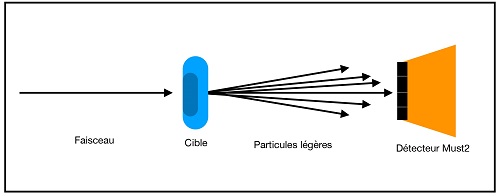
Principle of an interaction
Collision between the particle beam and a target, followed by the detection of particles by the MUST2 detector.
© GANIL
MUST2 consists of a set of 8 telescopes.
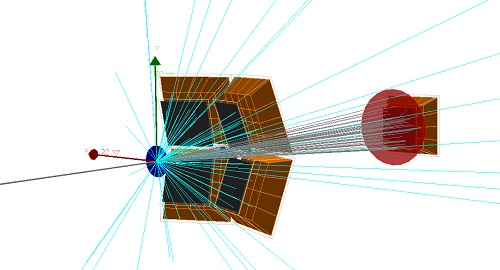
MUST2: collision simulation
This figure shows the particle beam (black line) hitting a target (blue disk). Light particles are emitted (light blue lines) and detected by 4+1 MUST2 telescopes. The red disk is a protection against the beam.
© V. Girard Alcindor
Each telescope consists of 3 detection stages.
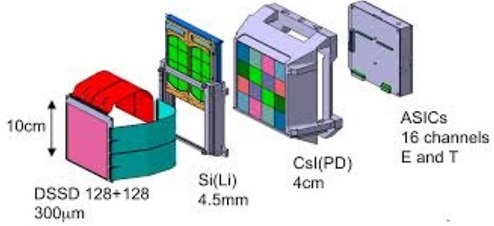
Detail of a telescope (MUST2)
A MUST2 telescope consists of 3 detection stages and an electronics stage (ASICs).
© GANIL
The first stage consists of a silicon detector, in the form of a 300 µm thick flat sheet with a surface area of 10 × 10 cm². The surfaces contain 256 metallic strips arranged in a grid to measure the position where particles pass through. There are 128 horizontal strips and 128 vertical strips. When a particle passes through the detector, an electric current is created in one of the strips and transmitted through the strip to a pre-amplifier (electronic equipment) that amplifies the electrical signal. The strips activated provide the X and Y positions of the particle. The intensity of the current in the strips gives the energy lost by the particle. The arrival time of the electrical signal gives the particle’s travel time, with a precision of around one billionth of a second.
The second stage consists of a 4.5 mm thick silicon detector (doped with lithium). This second detector detects the particle only if it has passed through the first stage. Its purpose is twofold. First, it measures the remaining energy of the particle. Second, it identifies the particle. Indeed, when the energy lost by the particle in the first detector (DE) is plotted as a function of the energy measured in the second detector (E), a characteristic pattern is obtained that allows particle identification. Different particles can have the same energy but different masses and different electric charges. A light particle will tend to pass easily through the first stage (DSSD), without losing much energy, and stop in the second stage, whereas heavier particles tend to slow down significantly in the first stage. All this information is recorded as data and represented graphically.
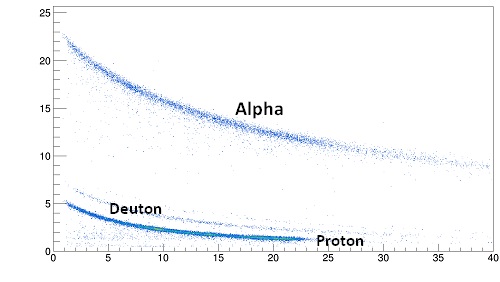
Particle identification measurement
The energy loss measured in the first detector (vertical axis) is plotted as a function of the energy measured in the second detector (horizontal axis). Each point in this image represents a measured particle. The lines of points correspond to different types of particles (protons, deuterons, alpha particles) with different energies.
© V. Girard Alcindor
The third stage consists of a cesium iodide scintillator detector. It is divided into 16 equal cubes. This stage is significantly thicker than the others (4 cm), as it is designed to stop the most energetic particles and measure their total energy.
MUST2 can receive up to 5,000 particles per second and makes it possible to measure signals with high quality (high time and energy resolution).
Note: This text was produced with the help of Marin Crochard (Lycée Notre Dame de la Fidélité – Douvres-la-Délivrande) during his research discovery internship in Year 10.
AGATA detector
AGATA (Advanced Gamma Tracking Array) is an array of semiconductor germanium detectors cooled to -200 degrees Celsius using liquid nitrogen. It measures high-energy electromagnetic radiation, also known as “gamma rays”, with very high precision (around 2 keV, depending on the energy). AGATA is a European research project. This detector is mainly used for fundamental research, to study the structure of the atomic nucleus. This detector array was installed at the GANIL laboratory for several years before moving to another European laboratory. It is one of the two best detector arrays of this type currently existing in the world. Its exceptional feature is its ability to determine the emission angle of gamma rays with a precision of about 1 degree. This information is obtained through “tracking” (trajectory reconstruction) of gamma rays inside high-purity segmented germanium crystals, using advanced digital electronics and analysing signal shapes.
The GANIL INDRA detector
A highly efficient detector
INDRA (Identification of Nuclei and Detection with Increased Resolution) is a charged particle detector dedicated to the study of hot nuclei formed in heavy-ion collisions, typically tin-on-tin collisions, between 20 and 150 MeV per nucleon. Experiments carried out at GANIL provide information on the properties of nuclear matter and its equation of state (pressure, volume, temperature, etc.). This detector entered operation at GANIL in 1993 and remains one of the most efficient detectors in its field.
… and ACTAR
ACTAR-TPC (Active Target Time Projection Chamber) is a detector developed at GANIL as part of an international collaboration. It is a system that simultaneously serves two functions: detector and target. Indeed, the gas filling the detector acts as the material in which nuclear reactions with the beam take place. At the same time, this gas is ionised (electrons are removed from atoms) by the beam particles and by the particles produced in the reactions, and this ionisation makes it possible to visualise the three-dimensional trajectories of these particles. This detector is therefore a kind of camera.