


Containing the radioactive ruins of the reactor
The explosion and subsequent fire left the reactor torn open. Fuel elements and heavy materials fell back into the destroyed unit, from which a deadly flow of radiation escaped. The reactor could not be left exposed in this way. Initially, helicopter pilots, risking their lives, dropped 5,000 tonnes of sand, lead, and boron: lead because it effectively absorbs radiation, boron to prevent potential fission reactions, and sand because it was abundant.
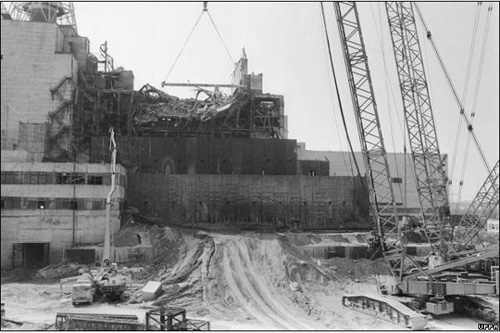
Once the immediate danger had passed, containing the radioactivity became the main challenge. Thousands of liquidators were mobilized to clean the surrounding area and build a vast steel and concrete structure over the reactor — the sarcophagus. It had to be sealed hermetically and protected from wind and rain in order to confine the radioactivity. BBC News 1986
A durable and solid protective structure had to be built over the damaged reactor to protect the environment and nearby populations. If the reactor had remained exposed to wind and rain, infiltrating water could have reached and contaminated rivers. Part of the remaining radioactivity would have spread into the environment.
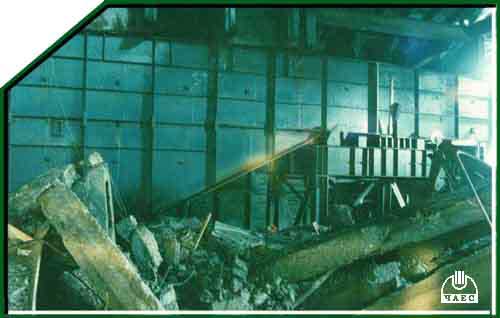
This low-quality but rare image likely dates from the construction period or shortly after. It shows part of the inside of the sarcophagus. Debris and concrete beams were hastily piled up. DR
The book by Paul Reuss and Michel Chouha, “Chernobyl: 25 Years Later…”, clearly describes the dangers faced by the liquidators who built the sarcophagus:
“Six months and six hundred thousand workers were required to build this unique structure. Working among twisted metal and radioactive dust, from the intense heat of summer to the freezing Ukrainian winter, these builders of the impossible faced the most hostile conditions, rotating in shifts measured by timers, to erect this fortress of steel and concrete, standing as a shield against the harmful effects of the radioactive debris from the damaged reactor.”
Over the years, criticism has been expressed regarding the construction quality of the sarcophagus. However, such criticism often overlooks the extreme difficulty of the task, the radioactive environment, and the extraordinarily harsh working conditions.
The structural stability of the sarcophagus has also been a frequent concern. What would happen if it collapsed? While such a scenario must be prevented, it should not be presented as a second Chernobyl. There would be neither explosion nor fire to disperse radioactive material into the atmosphere. Radioactivity has significantly decreased since 1986. Short-lived radionuclides, such as iodine-131, have disappeared. Volatile elements have already dispersed. The remaining radioactivity, buried under sand and concrete and covered by the sarcophagus, mainly consists of less mobile elements. A collapse would not be sufficient to spread them far; debris would largely fall in place.
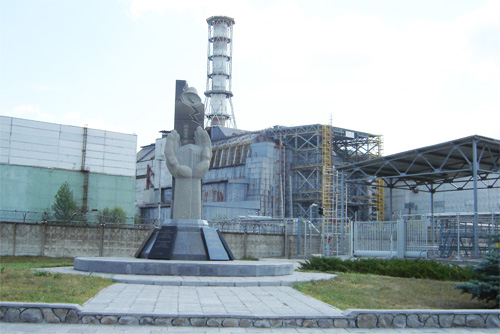
Now a familiar silhouette, the sarcophagus covering the damaged reactor has become part of the Chernobyl landscape, with a monument visible in the foreground.
To prevent such a possibility, the construction of a new arch-shaped confinement structure was undertaken. Work began at the end of 2010, with commissioning planned for 2017. This large arch now covers and protects the sarcophagus. This protective structure makes it possible to carry out the long-term dismantling of the damaged reactor.
In November 2016, the installation of the large arch began, with full operation expected in December 2017.