


A violent fire: an inferno of flames and radioactivity
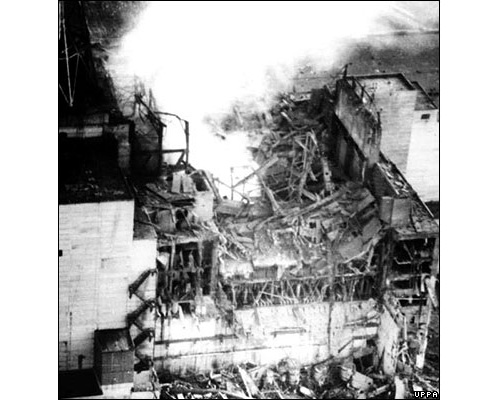
After the explosion, a violent fire
The explosion of the Chernobyl reactor on April 26, 1986, was followed by a violent fire fueled by the heat released and by the tons of graphite present in the reactor core.
The firefighters’ intervention was heroic.
To the inferno of flames was added the inferno of intense radioactivity: 28 of the firefighters who fought the main blaze lost their lives as a result of their exposure.
© UPPA/BBC News 1986
The blast that blew off the reactor’s upper plate left the reactor core exposed.
An intense, deadly radiation escaped from the radioactive ruins.
With no cooling remaining, the enormous heat generated by radioactive decay ignited the large mass of graphite used to slow down neutrons.
A gigantic fire broke out, adding to the tragedy.
A detailed account of this fire can be found in the excellent book by P. Reuss and M. Chouha, « Chernobyl, 25 Years Later… Fukushima » (2011, p.139):
« A gigantic fire was generated by the explosion. The large quantity of graphite inside the reactor fed the flames for a long time.
During the first minutes, and even the first hours, it was this fire that drew all attention.
The first firefighters arrived in less than 10 minutes but quickly realized they faced an extraordinary situation.
With the meager means at their disposal, they fought as best they could in an apocalyptic environment.
Reinforcements came from nearby towns.
With a strong sense of duty and patriotic spirit, these men gave everything they had with incredible courage.
For several hours, they worked in a highly radioactive environment, the effects of which were not immediately felt, completely overshadowed by the hellish flames surrounding them.
By 5 a.m., their courage prevailed: the main fire was under control. »
After the main blaze was extinguished, smaller fires continued for about ten days.
During that time, the column of smoke rising from the reactor carried radioactive dust and gases into the atmosphere.
These were later dispersed by the winds across northern and western Europe.
Because of terrain and rainfall patterns, radioactive particles from the Chernobyl cloud settled mainly in Ukraine, Belarus, and Russia, contaminating the soil.
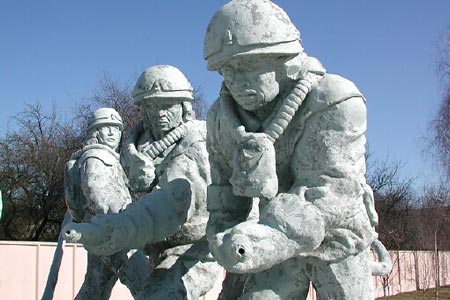
Monument to the Chernobyl firefighters
The explosion triggered a violent fire.
The large amount of graphite in the core fed the flames for a week.
The first firefighters arrived within ten minutes, soon joined by reinforcements from nearby towns.
For hours, these heroic men fought surrounded by flames in a highly radioactive environment until they finally brought the main fire under control.
Around thirty of these firefighters died from burns and intense radiation exposure.
A monument in their honor now stands on the Chernobyl site.
© Petr Pavlicek/IAEA
The plant personnel and firefighters involved in the accident received very high—mostly external—radiation doses, ranging from fractions of a gray to over 10
grays (Gy).
About thirty Chernobyl firefighters sacrificed their lives, dying from burns and acute radiation syndrome in the days or weeks following the accident.
A monument was erected in their memory near their fire station, inside the exclusion zone.
Once the main fire was extinguished, tons of various materials were dropped onto the reactor ruins to bury radioactive products and limit the intense radiation being emitted.
More than 5,000 tons of materials—mainly lead, boron, and sand—were dropped by helicopter in the following weeks.
Poorly protected, the pilots received excessive radiation doses, and several died in the days that followed.
This inferno of flames and radioactivity should not be confused with the forest fire that broke out 34 years later, in April 2020, in the exclusion zone around Chernobyl.
Hundreds of hectares of forest burned.
While local measurements showed some increases in radioactivity, levels remained low.
In Ukraine’s capital, Kyiv, about 100 km away, radiation levels stayed within normal limits, although the smoke from the forest fire near the nuclear plant blanketed the city, making its air pollution among the worst in the world
(BBC report, April 17, 2020).
Situation report on fires in Ukraine
— RGN article, April 2020
DOCUMENTS ON THE CAUSES AND DEVELOPMENT OF THE ACCIDENT
– 1) An ill-fated test: a series of errors and rule violations
– 2) Design flaws (RBMK) at Chernobyl