


Analyzing objects in air using particles accelerated under vacuum
Editorial revision 2026
The ions used for the analysis of museum objects in AGLAE (mainly protons) are accelerated under vacuum. For reasons of size and fragility, it is generally excluded to subject works of art to vacuum and therefore preferable to analyze them in air. It is therefore necessary to transfer this particle beam from vacuum to air without altering its energy and direction. This was the challenge faced by physicists and engineers.
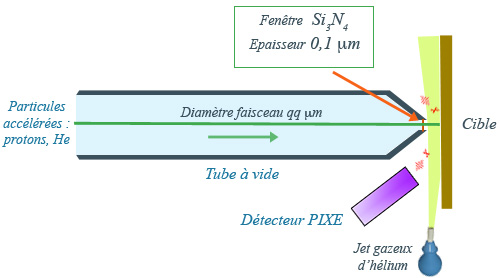
Principle diagram of the beam extracted into air
The particle beam leaving the accelerator travels in vacuum. To reach the object to be analyzed located in air, it must pass through a window. In order not to alter the quality of the beam, this window must be as thin as possible – one tenth of a micron for AGLAE – and therefore of very small surface area. The beam has been focused, its diameter reduced to a few microns in order to perform highly localized analyses. To reduce particle scattering during their short path from the window to the target, a jet of helium, a very light gas, is injected. Around the window are placed detectors that collect the particles emitted during the beam impact.
© IN2P3
A major technical development carried out on AGLAE was the production of beams extracted into air, which allow direct contactless and sampling-free analysis (therefore totally non-invasive) of art or archaeological objects of any size or shape. This decisive progress is achieved using a beam extracted into air through an ultra-thin exit window. This window is sufficiently resistant to withstand atmospheric pressure and the damage created by the beam, but thin enough not to degrade the incident beam.
The object is then freely placed a few millimeters downstream of this window.
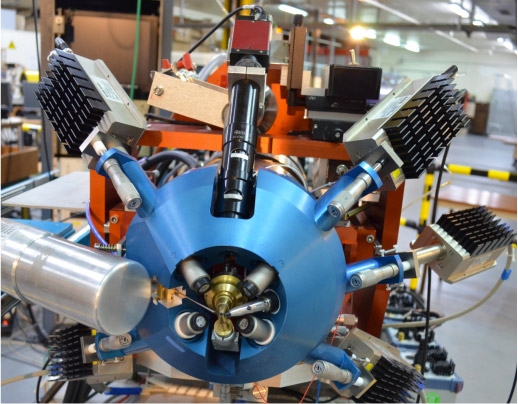
Beam exit
At the center can be seen the AGLAE beam exit window surrounded by monitoring devices and X-ray detectors (notably for PIXE methods) and backscattered particle detectors (for the RBS method).
© C2RMF
The addition of a magnetic focusing device to the extracted beam line enabled another decisive advance. It thus became possible to obtain an extracted microbeam allowing direct analysis of museum objects at atmospheric pressure with considerably increased spatial resolution precision (resolution). By using a 0.1 micron thick silicon nitride (Si3N4) exit window, a beam diameter of about 20-30 microns is achieved by placing the object 3 millimeters from the window under a helium atmosphere. Such a beam size now makes it possible to analyze small details such as inclusions in gems or illuminations.
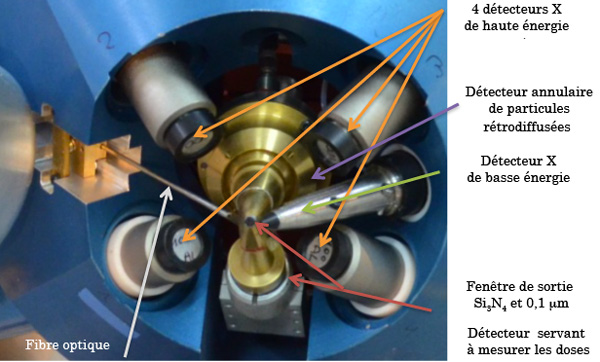
Devices surrounding the exit window
At the center can be seen the AGLAE beam exit window surrounded by monitoring devices and detectors: 4 high-energy X-ray detectors; 1 low-energy X-ray detector; 1 annular backscattered particle detector surrounding the exit window; one detector used to measure the dose, that is to say the beam intensity.
© C2RMF
A recent improvement consisted in considerably reducing the beam intensity in order to reduce the risk of damage to the most fragile objects (paintings, manuscripts). This was achieved by increasing the sensitivity of the detection system for X-rays emitted by the target through the use of several detectors: 4 for high-energy X-rays plus 1 for low-energy ones.
The multiple detectors placed in the immediate vicinity of the exit point thus allow simultaneous use of the various analysis methods, notably PIXE and RBS. High-energy X-rays, rarer than low-energy ones, require more detectors. Backscattered particles (RBS) are detected by an annular detector surrounding the exit.