


Space accidents involving onboard radioactive sources
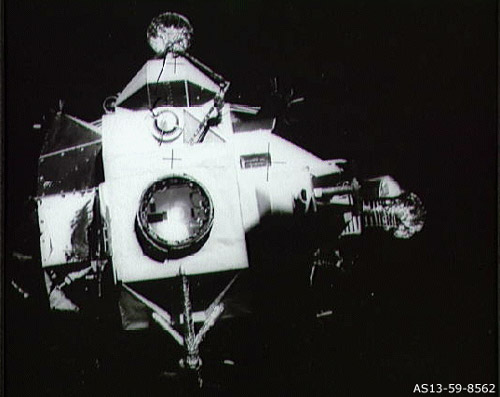
The Apollo 13 lunar module
The reentry of Apollo 13 into the atmosphere required separating from the lunar module that had accompanied the return flight to Earth. This module remained attached to the spacecraft in order to conserve as much life-support resources as possible for the return. Reentry thus proceeded without incident for the astronauts, but the lunar module fell into the ocean with its plutonium-powered electricity generator.
© NASA
The use of radioactive isotopes for satellites and space missions carries the risk of dispersing radioactive materials into the environment during launch or reentry to Earth. Six accidents have involved spacecraft powered by plutonium-238 radioisotope thermoelectric generators (RTGs). The most well-known is that of the Apollo 13 mission. These accidents are relatively old. Today, solar panels are used more frequently. RTGs are mainly reserved for deep-space exploration, and radioactive material containers are designed to withstand atmospheric reentry.
The first accident, which occurred on April 21, 1964, was the failed launch of the U.S. Transit-5BN-3 communications satellite, which burned up during reentry into the atmosphere north of Madagascar. Its 630 TBq of metallic plutonium were dispersed into the atmosphere of the southern hemisphere, and traces of plutonium-238 were detected a few months later. The Nimbus B-1 weather satellite had to be destroyed in flight on May 21, 1988, due to an erratic trajectory. Its SNAP-19 generator containing plutonium oxide was found intact 5 months later at the bottom of the Santa Barbara Channel. No contamination was detected.
In April 1970, the explosion of an oxygen tank led to the early termination of the Apollo 13 mission to the Moon. Apollo 13 included a lunar module designed to allow a moon landing and provide a base of operations and habitation on the lunar surface. Due to the accident, the module served as a lifeboat, its reserves of energy, oxygen, and water allowing the crew to benefit from vital resources during the emergency return to Earth. At the time of reentry, it was necessary to separate from the lunar module, which burned up over Fiji in the Pacific.
The graphite shell of the SNAP-27 RTG, which contained 1,650 TBq of plutonium-238 oxide, had been designed to withstand atmospheric reentry. Seawater tests conducted by the Department of Energy (DOE) showed that the container casing, which lies at the bottom of the Tonga Trench under 6 to 9 km of water, remained intact. Subsequent analyses showed no increase in background radiation levels in the region. The casing is expected to withstand at least 10 half-lives (870 years), after which the activity of the plutonium will be reduced by a factor of 1,000.
The extreme conditions of the Apollo 13 accident helped validate and improve the design of RTGs for subsequent missions. To minimize the risk of radioactive dispersion, RTG fuel is placed in modules with their own thermal shielding.
On the Soviet side, the failed launches of two Cosmos missions, which carried lunar rovers powered by RTGs, contributed to the release of radioactivity. The sixth accident was the launch on November 16, 1996, of the Russian Mars 96 probe. The two RTGs onboard, containing 200 g of plutonium-238, had been designed to survive atmospheric reentry and now lie at the bottom of the sea off Iquique, Chile.
Satellites or spacecraft that have released radioactivity carried at most a few kilograms of plutonium-238. These kilograms should be compared to the 10 tons of plutonium released from 1949 to 1980 during atmospheric nuclear tests.
There were also, between 1973 and 1993, five failures of Soviet spacecraft that used energy produced by onboard mini-reactors.
More recently, we can mention the mysterious accident that occurred on August 13, 2019, in the far north of Russia. An explosion occurred during what appears to have been a test of a nuclear-powered missile.
EURONEWS report on the explosion of a Russian missile during the August 8, 2019 accident.
The explosion caused the death of 5 employees of the Russian nuclear agency Rosatom. Radioactive materials were released into the atmosphere due to the explosion. After the accident, radiation levels measured around the base reportedly increased by a factor of 16. The base is part of a military research center known for having developed the USSR’s first nuclear weapons. As a result, Russian authorities have provided very little information about the accident.
What really happened in Russia? C dans l’air program of 13/8/2019.