


A historic agreement
The agreement signed on July 14, 2015 between Iran and the major powers was supposed to resolve the issue of the Iranian nuclear program. For the agreement to take effect, Iran first had to dismantle part of its facilities. At the beginning of 2016, the IAEA (International Atomic Energy Agency), responsible for verifying compliance with these commitments, concluded that Tehran had fulfilled them. The IAEA report gave the green light for the full implementation of the historic agreement concluded in July, leading on January 16, 2016 to the lifting of international sanctions, immediate for the European Union and gradual for the United States.
According to the terms of the agreement, Iran’s civilian nuclear program was reduced to very little. The aim for the major powers was to ensure that Iranian facilities could not be diverted toward the production of an atomic weapon. This civilian program, despite the concerns it raised, was not very developed. For example, the 15 tons of enriched uranium accumulated at Natanz could only have fueled the single reactor at Bushehr for 8 months. The origin of this civilian program resulted from the isolation the country had faced for decades due to sanctions and embargoes. It enabled the development of skills and expertise. Once isolation was lifted, further development of civilian nuclear energy was expected, as indicated by the order of two new reactors from Russia.
The fate of this civilian program was of little importance compared to the benefits that the Iranian population hoped to gain from the end of sanctions and openness to the world. Sanctions had mainly brought hardship. All this was undone after the Trump Administration tore up the agreement in 2017.
Source: Iran nuclear deal: Key details (BBC 16/01/2016)
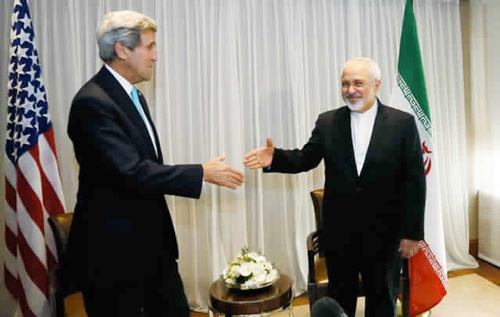
Iran: nuclear agreement
The agreement of July 14, 2015 owes much to U.S. Secretary of State John Kerry and Iranian Foreign Minister Mohammad Javad Zarif. They were its main architects and driving forces. It also owes much to the moderation and search for dialogue of President Hassan Rouhani. Through the warm handshake of two men, one can hope that 36 years of acrimony pass into history.
© BBC
URANIUM ENRICHMENT PATHWAY
Iran’s stockpile of low-enriched uranium would be reduced to 300 kg (in UF6 compound form), i.e. by 98%. The enrichment level would have to remain below 3.67%. These 300 kg, if enriched to more than 90%, would be insufficient to produce a bomb. The surplus of low-enriched uranium stock, which amounted to about 15 tons before reduction, was shipped to Russia in January 2016.
Furthermore, also in January 2016, Iran drastically reduced the number of its installed centrifuges: from nearly 20,000 at Natanz in 2015 to a maximum of 5,060. Only the oldest and least efficient IR1 centrifuges were allowed. This limitation was planned to last 10 years. Research and development would take place only at Natanz and would also be limited to 8 years.
No uranium enrichment would be allowed at Fordo for 15 years, and the underground facility would be converted into a nuclear, physics, and technology research center. The 1,044 centrifuges at the site would produce radioisotopes used in medicine, agriculture, industry, or science.
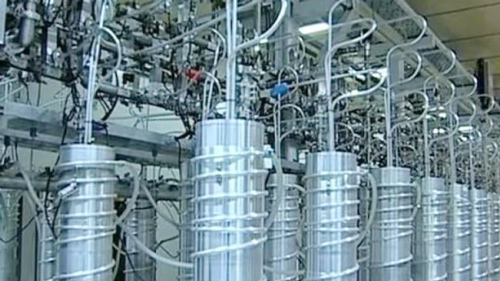
Natanz: Reduction of centrifuges
According to the terms of the July 14, 2015 agreement, Iran had to reduce the number of its centrifuges installed at Natanz from about 20,000 to 5,000, without being able to use its most modern and efficient IR2 centrifuges or exceed the limit of 300 kg of low-enriched uranium. The 1,044 centrifuges installed at the underground Fordo facility could not be used for uranium enrichment.
© DR
After the withdrawal from the agreement by the Trump Administration, Iran resumed uranium enrichment. In November 2020, the stock of low-enriched uranium reached 2,442.9 kg, 12 times the limit set by the agreement, a limit that was close to zero (equivalent to a few days of nuclear reactor fuel). The increase remained under IAEA supervision.
Iran’s enriched uranium stockpile 12 times limit, says IAEA : BBC, Nov 12, 2020
PLUTONIUM PATHWAY
Iran had under construction a heavy water reactor near the city of Arak. Spent fuel from heavy water reactors contains plutonium that can be used for a nuclear bomb. Because of this risk, the major powers wanted the dismantling of Arak. In November 2013, Iran had already agreed not to put the reactor into operation.
According to the agreement, Iran agreed to modify the reactor design so that it could not produce weapons-grade plutonium. This transformation would be carried out with China. All spent fuel produced by the modified reactor was to be removed from the country.
Most of the 20 tons of heavy water produced to date or in progress was to be shipped to the United States via a third country. About 6 tons would be kept for isotope production for medical purposes.
According to the July 2015 agreement (JCPOA), Iran was not allowed to build additional heavy water reactors or accumulate excess heavy water for the next 15 years.
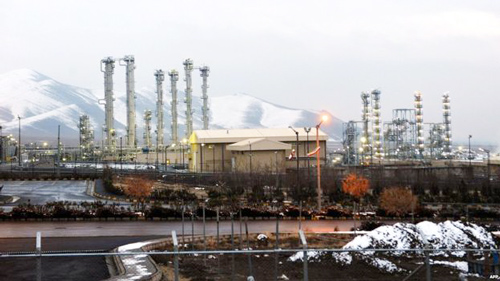
ARAK: Reactor redesign
The Arak reactor will not be commissioned in its current design. This small 40 MWth reactor using natural uranium as fuel was associated with a heavy water production unit. The heavy water facility had been commissioned, but not the reactor. In principle, the whole installation was intended to produce isotopes, particularly for medicine, but if diverted from these objectives it could produce weapons-grade plutonium. The reactor core will be modified so that it cannot produce weapons-grade plutonium in its fuel.
© BBC
PREVENTING HIDDEN ACTIVITIES
Iran has been accused of hidden activities. History will determine whether the nuclear threat was paranoia or reality. The precedent of weapons of mass destruction, which was one of the justifications for the Iraq war in 2003, calls for caution.
In 2007, a report by U.S. intelligence services concluded that Iran had had a nuclear weapons program but had halted it in 2003. When discovered in 2002, this not very advanced program had reached the stage of creating a pilot facility at Natanz.
According to IAEA Director Yukiya Amano and the Agency’s final report published in 2016, Iran conducted coordinated activities until 2003 that could have led to the development of a nuclear explosive. Some of these activities may have continued until 2009, but after that date there were no credible indications of development toward a nuclear weapon.
The agreement included provisions to prevent the development of a secret military program. For its part, Iran committed to submitting to an extraordinary and robust regime of monitoring, verification, and inspection. IAEA inspectors were to continuously monitor Iranian nuclear sites and ensure that no fissile material was secretly diverted to another location to build a bomb.
In accordance with the agreement, Iran was to voluntarily apply the Additional Protocol to the Non-Proliferation Treaty (NPT), which allows the IAEA to have in-depth control of nuclear activities through enhanced inspections. The irony of history is that Iran had already proposed in 2004 to sign such a protocol: President Hassan Rouhani was the Iranian negotiator at the time! Unfortunately, the major powers did not respond to this opening. The Additional Protocol was not ratified. Inspections continued, but were reduced to the minimum provided for by the Non-Proliferation Treaty.