


A Series of Measures to Improve the Safety of RBMK Reactors
After the accident, a number of RBMK reactors were shut down, particularly those located at the Chernobyl site, where the last unit was closed in 2000. With the help of the international community, major efforts were undertaken to improve the other RBMK reactors that continued producing electricity in Russia and elsewhere.
Initially, the objective was to halt as quickly as possible, or at least reduce as much as possible, the most serious design flaws: these were the post-Chernobyl measures. Later, modernization programs were implemented, aimed at thoroughly addressing issues related to the safe operation of these reactors: core physics, safety systems, backup systems, etc.
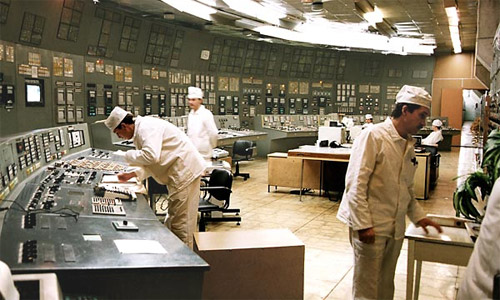
RBMK Control Room in 1999
Control room of Chernobyl Unit 3, the twin unit of the damaged Unit 4. In 1999, thirteen years after the accident, it had already benefited from the “post-Chernobyl measures” and had been considerably modernized. Operating procedures had been revised and a safety culture had been established.
@ Wikimedia / Source: Argonne National Laboratory
Post-Chernobyl Measures
The post-Chernobyl measures were implemented immediately after the accident in order to urgently correct the design flaws that existed at the time. They affected all reactors.
The main measure was to counter the “positive void coefficient,” this source of instability at low power whose effect was to amplify changes in core reactivity during the accident. To reduce the destabilizing effect of this positive coefficient, a number of fixed absorber rods were added to the RBMK core in place of fuel elements, and the uranium-235 enrichment level was increased in compensation. While these measures did not make the void coefficient negative, they significantly reduced it.
The following measures aimed to improve control systems, particularly the emergency shutdown system. To compensate for the very slow insertion time (18 seconds) of the absorber rods, a rapid shutdown system with 24 new rods capable of full insertion in 2 to 3 seconds was installed. The tips of the absorber rods, which initially accelerated fission reactions instead of suppressing them during insertion, were corrected. New alarm signals were also installed to trigger emergency shutdown.
The third set of measures consisted of improving the depressurization system. Since RBMK reactors had no containment building, protection relied on the strength of the pressure tubes. The rupture of a few tubes had been anticipated, but not the failure of a large number as occurred during the accident. To quickly relieve pressure in accident situations, a pressure reduction system using steam condensation was installed.
Finally, with international assistance, particularly from IRSN for France, operating procedures were completely revised and a safety culture was introduced. A safety culture did exist in the former Soviet Union, but it was sometimes secondary to production requirements.
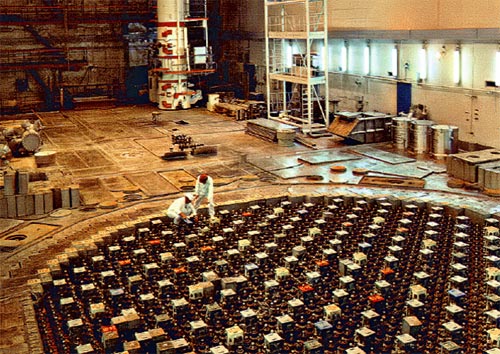
Ignalina RBMK Reactor (Lithuania)
Large reactor hall at Ignalina in Lithuania, showing the tops of the pressure tubes and, in the background, the refueling machine. Lithuania had two powerful 1500 MWe RBMK reactors on its territory, which were shut down despite their modernization (the last one at the end of 2009), due to European Union requirements. This small country, once ranked among the leading nations for the share of electricity generated from nuclear power, is now entirely dependent on foreign sources for its electricity supply.
@DR
A Major Modernization Program
The safety of RBMK reactors was significantly improved through modernization programs. To such an extent that these reactors can now be favorably compared with their Western counterparts, using the terminology from before 1986. The Ignalina reactor, whose closure was required by the European Union as a condition for Lithuania’s accession, was more a victim of prejudice against RBMK reactors than of its actual performance.
It takes approximately 4 to 5 years to fully modernize one unit. Modernization involves hundreds of physical and technical improvements: reduction of core instability, modern and efficient control systems, emergency cooling systems, leak detection systems, improved confinement capability, in-service inspection programs, operator assistance systems, etc. Completion of modernization programs for the last reactors was planned for around 2012.
The modernization program required substantial financial and human resources, as well as the support of international experts. The cost of RBMK modernization was estimated at approximately $200–300 million per unit (around $3–4 billion in total). This amount is minimal compared with the economic and human cost of the disaster, particularly the evacuation of the entire population living within a 30 km radius of the plant. According to “official” sources (the figure should be treated cautiously), the cost of the Chernobyl accident would amount to approximately $175 billion.
RETURN TO PAGE RBMK Reactors