


Deaths at Chernobyl? A dispute over numbers
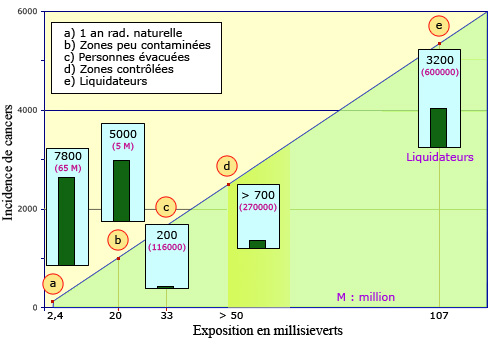
Cancer risks as a function of dose
Calculations of the number of cancers expected from Chernobyl are based on the « linear no-threshold relationship »: the probability or incidence of cancer is proportional to the dose received, at roughly 50 cancers per millisievert for one million people. This relationship is represented by a straight line. For example, in (a), 7,800 French people would develop cancer each year due to natural radioactivity: the dose is low (2.4 mSv) but affects a population of 65 million. For the four categories related to Chernobyl shown in the figure, the number of cancers is the product of this probability and the number of affected individuals indicated in red.
@IN2P3
Unlike deaths resulting from a hurricane, a volcanic eruption, or a tsunami, it is not possible to count the victims of an accident like Chernobyl. According to a United Nations report, the number of deaths clearly identified and occurring shortly after the accident was, in 2005, fewer than 50. As for deaths occurring years after exposure to radioactivity, there is no « signature » that allows them to be identified. Their number can only be estimated through calculation.
Twenty years after the disaster, the human toll of Chernobyl remains the subject of intense debate. A report published by the IAEA (International Atomic Energy Agency) in September 2005 sparked strong controversy. Yet this report was the result of a forum held between 2003 and 2005, involving respected and competent organizations such as the WHO (World Health Organization), UNSCEAR, the IAEA, and the FAO.
The report estimates 4,000 cancer deaths, confirmed or expected, among the most exposed populations of Ukraine, Belarus, and Russia. The calculation is based on the assumption that the probability of death attributable to radioactivity is proportional to the dose. Of these 4,000 deaths, 2,200 could occur among liquidators, 1,500 among residents of the most contaminated areas, and 150 among the 150,000 evacuees from the 30 km zone.
These considerable figures, provided by competent organizations, are far lower than some estimates popularized by the press and television. They are criticized by anti-nuclear movements as part of a disinformation campaign, described as « insulting to the victims ».
A Greenpeace report concluded that « 200,000 deaths caused by the disaster had already been recorded over the past 15 years in Russia, Belarus, and Ukraine ». On the occasion of the 25th anniversary of the accident in 2011, several television channels went even further, claiming that two-thirds of the liquidators were already dead. It is instructive to compare these figures with the conclusions of the 2008 UNSCEAR report, the United Nations Scientific Committee on the Effects of Atomic Radiation.

Catastrophe or not?
According to some media outlets, 400,000 deaths occurred over 25 years among the 600,000 Chernobyl liquidators. In 1986, the liquidators were young. Let us assume that over 25 years, 80,000 died of natural causes. That leaves 320,000 deaths — about 100 times the mortality predicted by experts. Logically, this multiplication by 100 should be applied to all other radiation exposures. The middle and right columns show that, multiplied by 100, natural radioactivity would decimate populations; X-rays and CT scans would fill cemeteries!
@IN2P3
Multiplying by 10 or even 100, under the influence of well-meaning but militant convictions, the estimates of competent organizations leads to absurd conclusions. The cells in our bodies do not distinguish whether radiation comes from Chernobyl or from natural radioactivity. Logically, one would have to multiply by 10 or 100 the risks attributed by experts to natural radioactivity, X-rays, and so on. In France, the number of deaths attributed to natural radioactivity would thus rise from 7,800 to 780,000 per year. If such a multiplication were real, many readers would not be here to read this page.
So what confidence should be placed in expert estimates? If nature allows even low exposure to trigger cancer, these figures are close to reality. On the other hand, if the body effectively repairs the effects of low doses in our cells, then individuals exposed to small amounts may escape the risk of cancer. In that case, the estimates would need to be revised downward.
Back to