


The marriage of a reactor and an accelerator
Hybrid reactor projects, combining accelerator technology and nuclear reactor technology, were revived in 1994 by the energy amplifier proposed by the 1984 Nobel Prize in Physics laureate Carlo Rubbia and his team at CERN.
The accelerator would be a proton accelerator with a kinetic energy at the output of around 1000 MeV, more than one hundred times the 8 MeV required to remove a nucleon from a nucleus. During a collision with a lead target, these protons eject on average about twenty neutrons. These neutrons are called spallation neutrons.
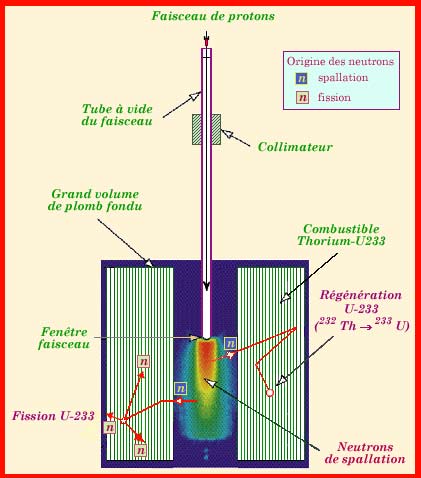
Fission and regeneration of uranium-233
This schematic diagram of the core of a hybrid reactor shows the proton beam propagating to this core and the “flame” of neutrons that reach the thorium and fissile materials immersed in molten lead. The two functions of these neutrons are illustrated: on the left, energy production by the fission of a uranium-233 nucleus; on the right, the regeneration of this fissile uranium-233 from the capture of a neutron by a thorium nucleus.
© IN2P3 (Source J.P. Revol).
In a conventional reactor, the primary “match” – the neutron source that triggers the first fission reactions – is generally composed of an alpha emitter and beryllium. It is internal to the reactor and cannot be controlled. In a hybrid reactor, on the contrary, the source is external: the primary neutrons are supplied via the accelerator. Since this source is abundant, there is no need to maintain a critical state to sustain the chain reaction indefinitely, and a fuel poorer in fissile elements is chosen. A neutron triggers only a limited number of fissions. The chain reaction has lost its explosive potential. The accelerator controls the reactor.
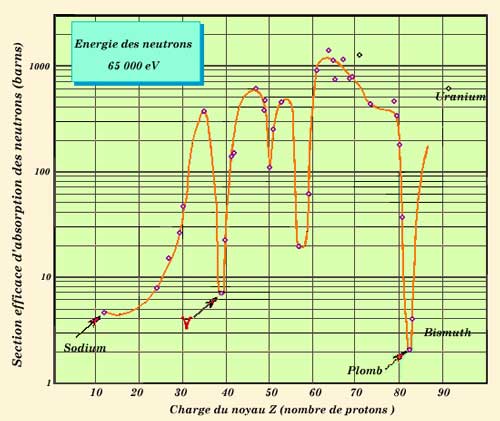
Transparency of sodium and lead to fast neutrons
Lead and bismuth would be used to remove heat due to their high transparency to fast neutrons. This transparency prevents these neutrons from being captured during the many collisions they may undergo before being usefully absorbed by fertile thorium or fissile uranium. The figure shows, for natural elements, the fast neutron capture cross-section, that is, their probability of capture (the curve is plotted for an energy of 65 keV characteristic of these neutrons). The capture probability appears particularly low for sodium and lead. Lead has the advantage over sodium of being less difficult to handle.
© CERN/IN2P3
Accelerated protons traveling in a vacuum must pass through a “window” to reach the target where spallation reactions will occur. The proposal by the Rubbia team is that the protons strike a molten lead target. Lead has excellent nuclear properties (high transparency to neutrons), but it is corrosive in liquid form. To reduce this corrosiveness, a mixture – called eutectic – of lead and bismuth (also transparent to neutrons) would be used.
In the past, lead-bismuth eutectics were used in fast neutron reactors of Soviet submarines.
A large hybrid reactor of 1.2 gigawatt of electrical power would be cooled by a mixture of 10,000 tonnes of molten lead-bismuth. This mixture would slow down, without capturing them, the spallation neutrons, remove the heat produced by convection (due to its good thermal properties), and finally confine radioactivity.
It is in this large volume of molten lead that the core of the energy-producing reactor would be immersed. The additional neutrons would provide great flexibility in the choice of fuel. Instead of uranium, thorium enriched with fissile elements such as plutonium produced in current power plants would be used. It is envisaged to burn in these reactors the waste produced by PWRs, such as actinides, while recovering the energy they contain. Such reactors would be primarily intended for waste incineration and secondarily for energy production.